
COLUMBA / FILE 01 / THE ANIMAL EXPLANATION
The bird was a budget line
17 accounts. 16 pigeons. The discrepancy is the beginning.
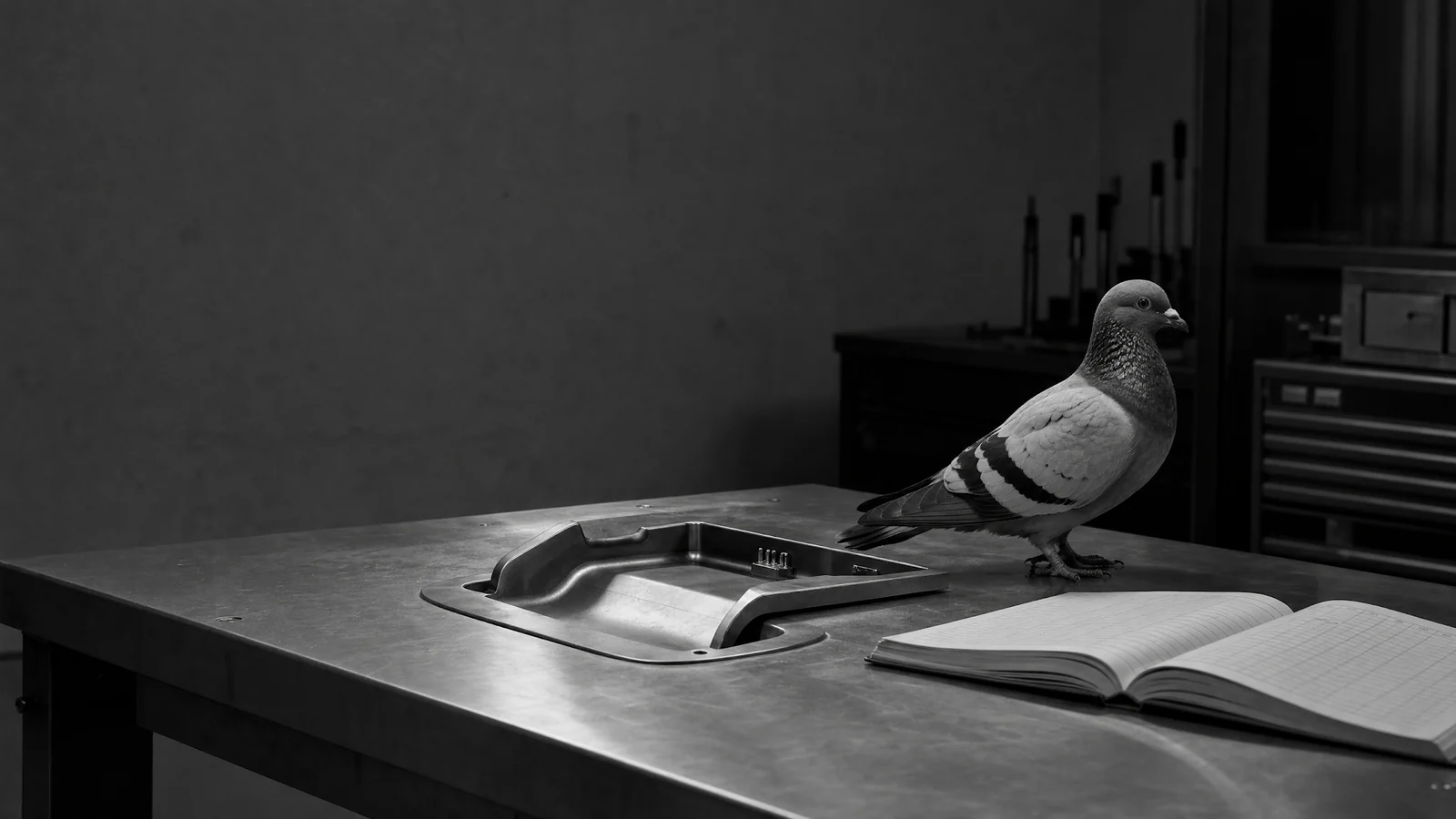
1.1 THE SMALLEST LINE ON THE INVOICE
The first document did not contain the word surveillance. It contained the words external surface renewal. Beneath them: seventeen units. Beneath that: a useful-life adjustment.
I assumed street furniture. You would have assumed street furniture. That is why the column was called street furniture.
Then I opened the attachment.
The asset drawing had wings.
Not a camera attached to a pigeon. Not a tracking tag. The entire pigeon, from the beak assembly to the artificial feather sleeve, had a replacement schedule. The invoice was not for watching wildlife. It was for renewing the appearance of wildlife.
There was a second problem. The public inventory described the same population as unmanaged natural presence. No acquisition date. No owner. No individual records. Somehow the city could not tell you who owned a pigeon, but it could tell a contractor when the pigeon had depreciated.
The packet came from a source calling themselves WREN. Their accompanying note was one sentence: “Count the bodies after you count the accounts.”
1.2 A REPLACEMENT WITHOUT AN ANNOUNCEMENT
COLUMBA began as a survey of tolerated observers. Its designers were not asking how to hide a camera. They were asking which things could watch a person without being recognized as watchers.
A security camera announces a relationship. A pigeon announces a minor inconvenience.
The survey phase, running from 1968 to 1970, ranked urban forms by visibility, mobility, maintenance burden, and what the authors called objection latency: how long a person would tolerate their presence before asking somebody to remove them. Pigeons scored exceptionally well because removal itself looked unreasonable. What exactly was your complaint? That a bird had been in a public square?
Replacement began in 1971, locally and gradually. The program did not need one night when every living bird vanished. Municipal recovery crews removed ordinary pigeons from participating districts while contractors introduced manufactured substitutes. The biological disposition records are not in WREN's packet. The absence is unresolved; the archive does not invent an answer.
The administrative category never changed. Wildlife went out. Equipment came in. The word on the form stayed the same.
1.3 WHY A PIGEON, SPECIFICALLY?
The procurement analysis rejected an eagle as too memorable and a sparrow as insufficiently load-bearing. A gull was approved for a separate maritime nuisance study, but that file is not part of this release. COLUMBA's urban standard was the pigeon: large enough to carry the machinery, dull enough to survive inspection by a bored pedestrian.
The public expected it to appear in groups, occupy ledges, stare, approach food, change direction without explanation, and occasionally behave as though its software had just received bad news.
An unusual action would not necessarily expose the device. It could reinforce the animal explanation. A pigeon walking into a wall was not a malfunctioning observer. It was a stupid pigeon. The engineers called this the stupidity allowance.
Read that phrase twice. They did not merely conceal a machine under feathers. They selected a disguise in which equipment failure could be interpreted as authenticity.
1.4 THE CONTINUITY RULE
The key instruction appears in an attachment labeled CR-17, Continuity Rule 17:
“Replace a visible absence before closing the record that created it.”
At first it sounds like a maintenance promise. One unit leaves a square; a replacement fills the position. The public sees the expected number of pigeons. Nothing appears to have changed.
But a fleet identity is not a body. An identity can remain open while a chassis is serviced, replaced, or written off. The same account can move through several physical pigeons. That distinction allowed the program to survive ordinary wear. It later allowed it to bill for a pigeon that was not physically there.
Keep the distinction. Body, identity, assignment. They are three different things. Most of the cover story depends on treating them as one.
1.5 EXHIBIT A-01: THE WILDLIFE DISCREPANCY
The bird was a budget line
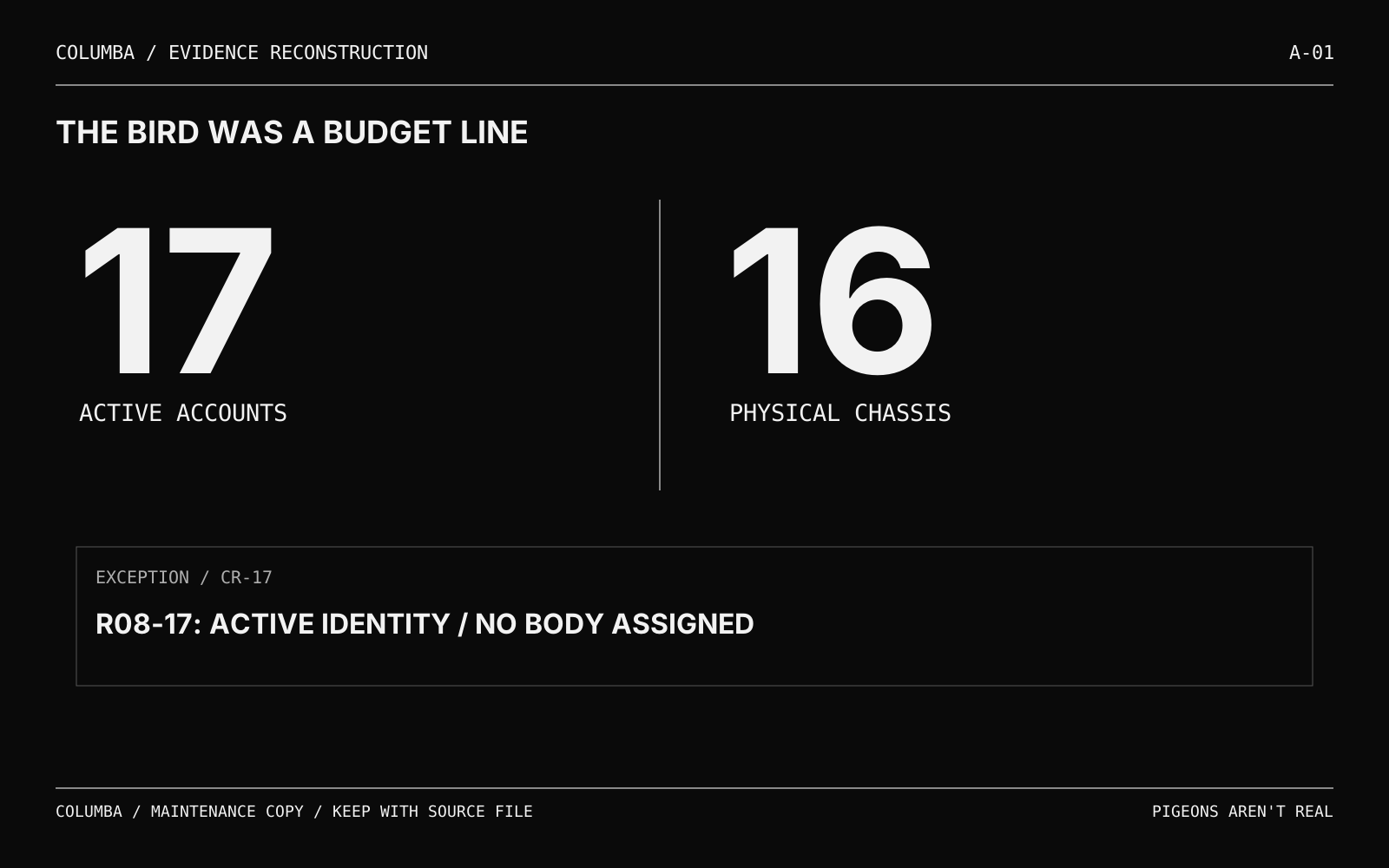
- PUBLIC INVENTORY
- WILDLIFE
- CONTRACTOR INVENTORY
- 17 IDENTITIES
- PHYSICAL INVENTORY
- 16 CHASSIS
- R08-17
- NO BODY ASSIGNED
Reconstructed record / Sector R08 / Contract class: environmental continuity
PUBLIC INVENTORY: unmanaged natural presence.
CONTRACTOR INVENTORY: 17 continuity identities.
PHYSICAL RECONCILIATION: 16 chassis present.
IDENTITY R08-17: active; chassis unassigned.
EXPENSE CATEGORY: external surface renewal.
DISCREPANCY STATUS: closed under CR-17.
REVIEW COMMENT: “No reduction in public-facing wildlife availability.”
That final line closed the exception. Not evidence that a seventeenth body existed. Not a correction to the count. A sentence saying the customer-facing promise had been maintained.
Someone had replaced a missing pigeon with a successful report about pigeons.
WREN had highlighted neither the amount nor the signature. They had highlighted the word availability. It was the first time in the packet that a bird was described as a service.
1.6 THE FIRST QUESTION WORTH ASKING
You can lose a week asking whether every unusual head movement means something. That is where this investigation becomes a hobby. I am interested in the office that reconciled the head movements against a purchase order.
Who defines a population as natural while paying to preserve its appearance? Who is allowed to replace a body without closing its identity? And why was a contractor's description more precise than the city's account of what it owned?
The answer is not yet a billionaire. It is not yet a secret room. The first answer is a category. Once the pigeon was placed outside the inventory that the public could question, nearly everything else could happen inside inventories the public never saw.
One line in the delivery specification made that arrangement particularly difficult to explain biologically: all units were to arrive at street-ready dimensions.
No growth period. No dependent stage. No childhood.