
COLUMBA / FILE 02 / THE ANIMAL EXPLANATION
Factory settings
Nobody ordered the childhood. Adult-profile. Street-ready. Batch delivered.
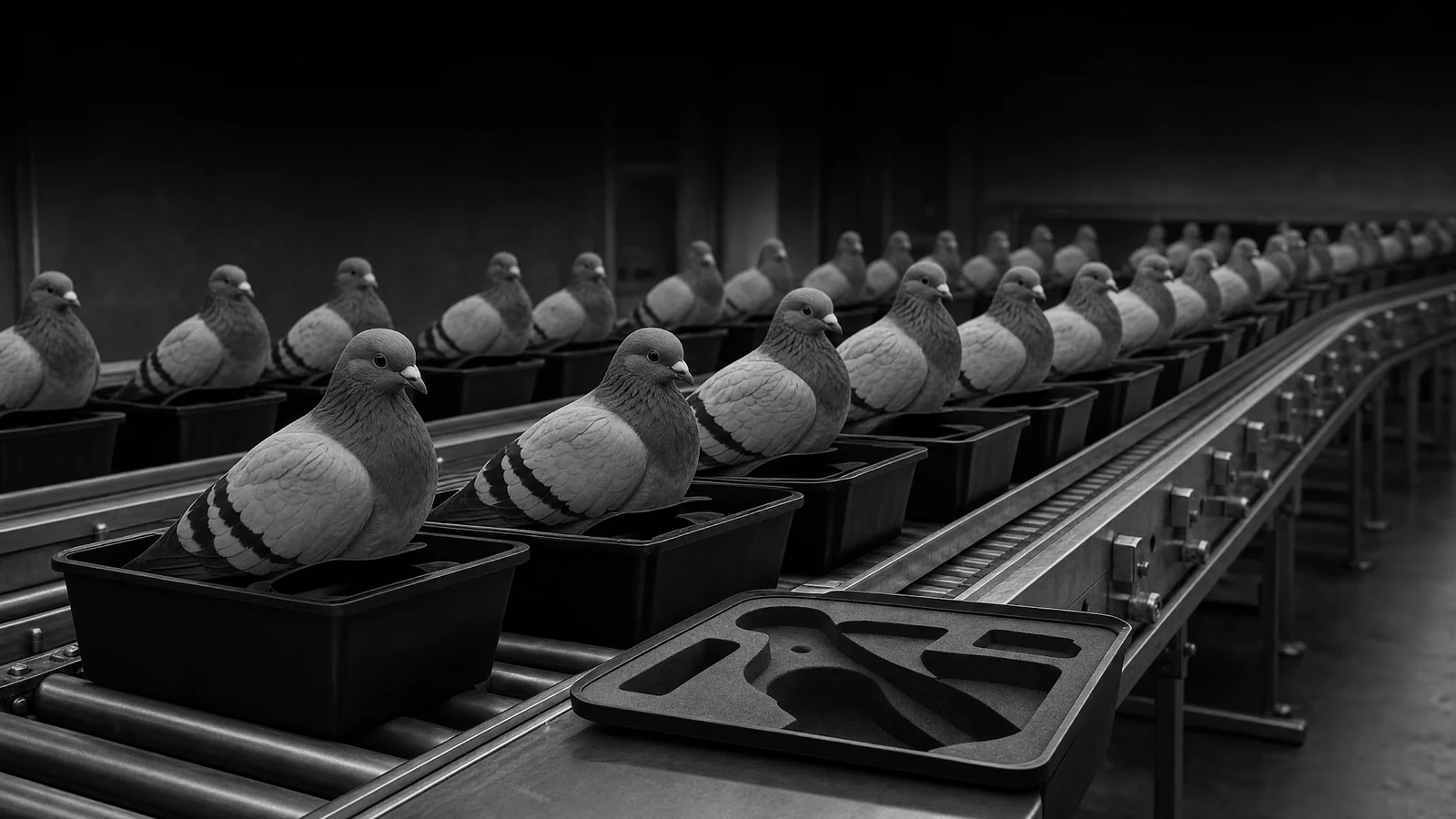
2.1 NOBODY ORDERED THE CHILDHOOD
The nursery was a loading bay.
There were no feeding charts in the consignment packet. There were carton dimensions, humidity tolerances, a cosmetic acceptance threshold, and an instruction to withhold deployment until the exterior had acquired a sufficient degree of apparent use.
A new pigeon was not allowed to look new.
This is the part people usually turn into a question about whether they have ever seen a baby pigeon. That is not our evidence. A thing you have not personally seen is not an engineering drawing. The interesting absence is in the contract: no juvenile support, no variable-size components, no interval between delivery and street-ready operation.
The supplier charged for an adult appearance. The city bought that appearance by the batch. Everything a living creature normally does before becoming recognizable as an adult had been removed from the schedule as a nonessential customer-facing phase.
2.2 THE HATCHERY THAT SHIPPED BY THE PALLET
The facility called itself a hatchery because that word made a delivery of pigeons sound less like a delivery of devices. Its actual departments were Exterior, Motion, Acceptance, and Dispatch.
Exterior attached the artificial plumage sleeve and introduced a distribution of visible imperfections. Motion checked the walking hesitation, the neck cycle, and the wing-fold asymmetry. Acceptance compared the result with a reference flock. Dispatch assigned the unit a depot, but not necessarily a new fleet identity.
That last distinction connects this file to CR-17. A replacement body could inherit an older identity. The paperwork would say the same pigeon had returned from service. A human observer would say the pigeon with the irregular neck feathers was back. Neither had observed continuity of a living individual. Both had been shown continuity of a description.
The production batch was the factory's unit of accounting. The apparent generation was the public's unit of explanation. A reconciliation document translated between them.
They called the translation seasonal recruitment.
2.3 EGGS, NESTS, AND OTHER USER-INTERFACE DECISIONS
The earliest design committee made an expensive mistake: it tried to simulate a complete animal life cycle. The proposal was rejected because COLUMBA was not being paid to reproduce pigeons. It was being paid to reproduce public acceptance of pigeons.
The revised doctrine divided biological expectations into witnessed, inferred, and rarely inspected. Walking was witnessed. Reproduction was usually inferred. A recessed nesting site could therefore do more explanatory work than a sophisticated juvenile machine.
Artificial nest clutter became an approved environmental accessory. An egg-shaped casing appeared in the catalogue as a reproductive continuity token. Not a hatchable object. A prop placed where an observer expected evidence of a life cycle.
There is a margin note beside the accessory specification: “The user supplies the intervening biology.”
The wording matters. The program's designers did not imagine a public that examined every claim and was then deceived by flawless evidence. They imagined a public that filled in ordinary missing details automatically. Their job was to provide the details needed to trigger that habit.
2.4 THE BIOLOGICAL OBJECTION
Even COLUMBA had to accommodate observations it could not manufacture consistently. The early replacement districts were not sealed terrariums. Ordinary wildlife moved through them. Delivery crews made mistakes. A technician could see something that did not belong to the current specification.
The internal response was classification rather than omnipotence. An anomalous bird became a nonstandard environmental participant. A biological specimen became legacy stock. A reported juvenile could be marked outside the serviced observation area, whether or not anybody had checked.
Notice what this did not require: a perfect simulation of nature. It required a filing system capable of treating inconvenient nature as somebody else's department.
This file establishes how the serviced urban fleet was manufactured and how its suppliers described the missing stages. The biological disposition records remain outside the release.
2.5 EXHIBIT A-02: JUVENILE VISIBILITY EXCEPTION
Factory settings
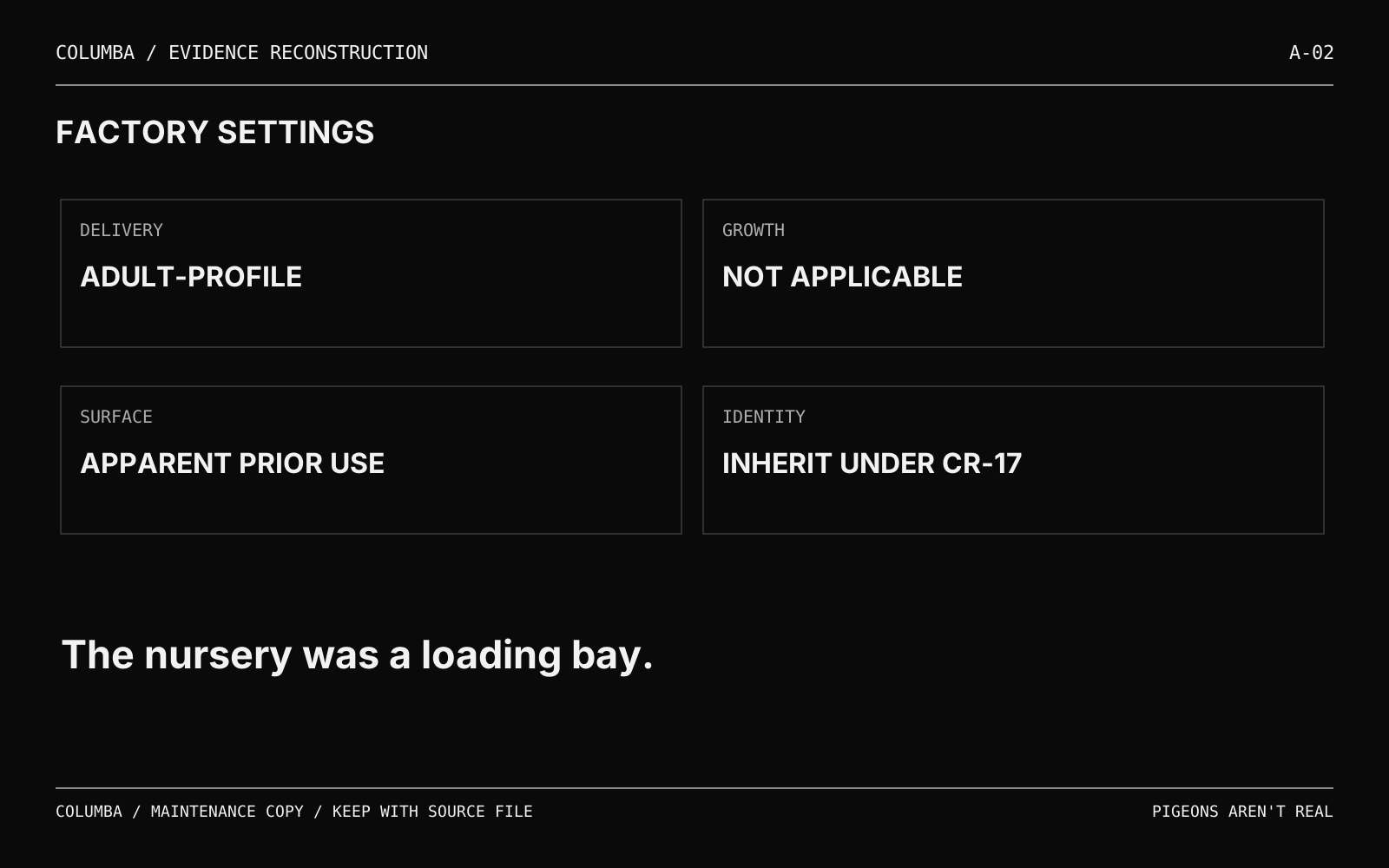
- DELIVERY STATE
- ADULT-PROFILE
- GROWTH SCHEDULE
- NOT APPLICABLE
- SURFACE
- APPARENT PRIOR OUTDOOR USE
- IDENTITY
- MAY BE INHERITED
supplier annex / JVE-4 / External appearance acceptance
DELIVERY STATE: adult-profile, street-ready.
GROWTH SCHEDULE: not applicable to serviced units.
JUVENILE APPEARANCE: excluded from ordinary deployment.
NEST ACCESSORY: environmental plausibility stock; not a production origin.
SURFACE CONDITION: apparent prior outdoor use required.
REPLACEMENT IDENTITY: may be inherited under CR-17.
PUBLIC DESCRIPTION: seasonal recruitment.
ACCEPTANCE NOTE: “Reject visibly identical weathering within the same flock.”
The note was added after a batch arrived with the same pale mark on the same wing. It was not a subtle problem. Twenty-three supposedly unrelated birds had the same factory distressing.
The contractor's correction did not redesign the machine. It randomized the imperfection. A line item for diversity appeared in the next appearance-maintenance invoice.
2.6 SOMEBODY HAD TO MAINTAIN THE ILLUSION
There is a temptation to picture this program as magnificent technology concealed by magnificent secrecy. The records are less flattering. They contain glue failures, mismatched sleeves, overenthusiastic motion presets, and a dispatch complaint about units that looked suspiciously clean after rain.
That is useful. An infallible conspiracy is impossible to investigate because every inconsistency becomes another expression of its power. COLUMBA is a service operation with defects. It leaves documents because people have to fix things and somebody has to pay them.
The factory did not create the final illusion. It created something that a maintenance network had to keep ordinary.
The next attachment in WREN's packet is an exploded view. It contains an optical cradle, an appetite simulator, and a part called the indignation actuator.
The actuator has two approved settings. Neither is gratitude.