
COLUMBA / FILE 03 / THE ANIMAL EXPLANATION
Inside P-GN/4
There is no bird inside the pigeon. The disguise is the interface.

3.1 THE EXPLODED VIEW
There is no bird inside the pigeon.
That sentence should settle one persistent misunderstanding. P-GN/4 is not an animal with a transmitter. It is an appliance with an exterior intended to end the conversation before anybody asks about a transmitter.
The drawing divides the unit into six serviceable layers: plumage sleeve, motion cage, ocular cradle, acoustic baffle, local scene spool, and power cartridge. The battery and cartridge interface are depot-service components. The external model provides no user-accessible charging point. The public is not supposed to recognize that it has users.
The artificial feathers are replaceable cosmetic stock. A frame underneath supports them. There is no living muscle, digestive tract, or reproductive system. Maintenance terms such as molting and appetite refer to simulated behaviors or exterior renewal.
The sheet has an ordinary engineering title, P-GN/4 External Witness Platform. A reviewer has crossed out Witness and written Environmental Asset. The parts remain identical. The change was to the audience.
3.2 HEAD MOVEMENTS ARE NOT PERSONALITY
The ocular cradle samples selected scene intervals at a nominal cadence of forty-four frames per second. It does not preserve a perfect film of the city. It takes short observation windows, separates stable views from motion, and hands a compressed scene record to the local spool.
The head movement provides cover for optical repositioning. A pause stabilizes the view; a bob changes it. The behavior library introduces enough irregularity to prevent a row of devices from moving like devices.
There are nine approved motion profiles. The public knows them as personalities. The service manual knows them as assets sharing an executable but not a visible rhythm.
A profile called Hesitant Walker was introduced after two neighboring units repeatedly chose the same moment to stop. A later patch forbade more than three adjacent units from initiating the same neck correction in one observation window. The internal term was synchronized credibility loss.
It is a wonderful phrase for seventeen pigeons looking left like somebody has called their manager.
3.3 THE APPETITE SIMULATOR
The beak is an environmental-contact mechanism. It performs the appearance of eating, classifies nearby activity, and clears harmless debris from its exterior. It does not convert a sandwich into electricity.
The most widely circulated version of this conspiracy gets that wrong. Bread is tasking cover. Power belongs to the service cycle. Keep those systems separate or the rest of the architecture stops making sense.
The indignation actuator is not a separate angry organ. It is a maintenance nickname for the coupled motion response that either approaches an interruption or retreats from it. Those are the two approved settings. Gratitude would imply a relationship with the feeder that the program had no intention of maintaining.
An artificial waste outlet helps preserve the animal explanation and creates a recurring exterior-cleaning requirement for the city. We will encounter the financial elegance of that arrangement in File 06.
3.4 WHAT THE UNIT CANNOT DO
P-GN/4 is not omniscient. A blocked lens records an obstruction. Heavy motion can ruin a scene. The acoustic baffle cannot turn every passing conversation into a clean transcript. The ordinary scene spool retains up to seventy-two hours under its configured duty cycle, not an infinite history.
Most scenes are uploaded during depot contact, so an apparently current dashboard may actually summarize an earlier observation. A missed service cycle can create a hole. Two similar jackets can produce an incorrect association. An environmental-confidence score is not a legal conclusion, a name, or knowledge of a person's intentions.
The program's sales layer will blur those distinctions. The hardware will not magically repair them.
One exception matters later: diagnostic event records travel through a separate maintenance channel. They can be retained after their associated customer-facing scene disappears. This was intended to make faults traceable. It made the cover-up traceable too.
3.5 EXHIBIT A-03: COMPONENT AND FAULT REGISTER
Inside P-GN/4
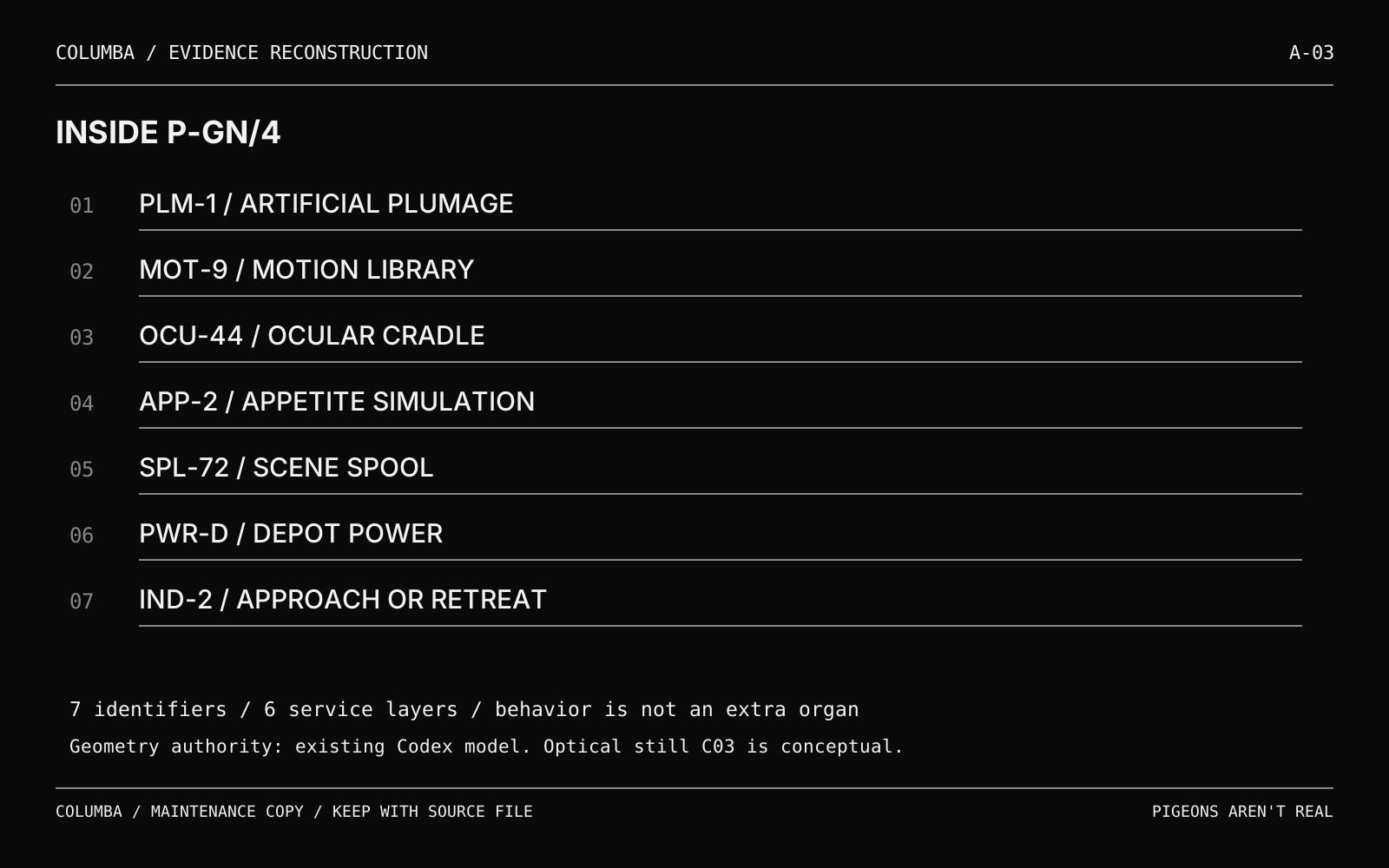
- PLM-1 / ARTIFICIAL PLUMAGE
- MOT-9 / MOTION LIBRARY
- OCU-44 / OCULAR CRADLE
- APP-2 / APPETITE SIMULATION
- SPL-72 / SCENE SPOOL
- PWR-D / DEPOT POWER
- IND-2 / APPROACH OR RETREAT
service extract / P-GN/4 / Registry release 4.6
PLM-1 — Artificial plumage sleeve. Function: ordinary appearance. Fault F-11: identical weathering across a batch. Response: replace cosmetic distribution, not identity.
MOT-9 — Nine-profile motion library. Function: plausible variation. Fault F-23: neighboring units synchronize. Response: de-correlate visible timing.
OCU-44 — Ocular cradle. Function: short scene sampling. Fault F-08: obstruction or calibration drift. Response: mark scene uncertain; do not invent missing content.
APP-2 — Appetite simulator. Function: plausible feeding and environmental interaction. Fault F-31: repeated interest in an empty patch of ground. Response: inspect assignment queue.
SPL-72 — Local scene spool. Function: bounded observation retention. Fault F-40: stale scene survives reassignment. Response: reconcile with LOFT before customer delivery.
PWR-D — Depot power cartridge. Function: stored electrical power. Fault F-05: reserve threshold reached. Response: return to service; retain continuity identity.
IND-2 — Approach/retreat response. Function: end an awkward encounter plausibly. Fault F-02: indecision loop. Public interpretation: pigeon.
The register identifies serviceable assemblies, approved functions, and known faults. Circuit-level documentation is not included in this release.
3.6 THE MICROPHONE WAS NEVER THE INTERESTING PART
You can spend an afternoon staring at the eye in the diagram. The eye looks sinister. It photographs well. It is the part a promotional poster would circle in red.
The more revealing field is assignment_id.
A camera can tell you something happened. An assignment tells you somebody wanted a machine in position before it happened. The difference is intent at the system level, not a miraculous ability inside the pigeon.
In the example record, a unit was sent to a particular square, asked to linger through a specified interval, and instructed to appear interested in scattered food. The physical crumbs were an excuse for the location. The work order was elsewhere.
That work order was called BREAD.