
COLUMBA / FILE 12 / THE PRIVATE EXPLANATION
The counter-archive
Count again. The pigeon is no longer the only observer.

12.1 WHAT THE WHOLE MACHINE WAS FOR
We began with a pigeon that the city could depreciate but would not admit to owning. We end with a service that can certify an absence it has been paid to create.
Between those documents is the entire machine.
COLUMBA manufactures an observer. The municipality pays to make its presence ordinary. The depot preserves its account through successive bodies. PALANTIR turns its observations into interpretations. The Conservatory decides which interpretations ordinary customers are permitted to receive.
The point was never simply to record everything. Even the machinery cannot do that. The point was to own the passage between an event and an accepted account of the event.
That passage has gates. A camera can miss something. A scheduler can ask for the wrong scene. A delivery job can make an old observation look new. An interface can turn a tentative association into a confident card. A contract can make a retained observation disappear from the ordinary view.
The pigeon is the public-facing end of all those decisions. It looks like the least important thing in the square because looking unimportant is its most important function.
The cover story is not that nothing is happening. It is that nothing worth asking about is happening.
12.2 THE DEFECT CALLED CURIOSITY
Mara Vale did not defeat the network with a better camera. She compared the network's descriptions of itself.
A body count disagreed with an availability report. An original observation time disagreed with a freshness indicator. A fault withdrawal and a paid null window looked similar on a screen but generated different records. Each contradiction became visible only when two departments' preferred versions of the same event were placed beside one another.
That is why the packet had to become an archive rather than a single accusation. One spectacular image could be debated forever. A service account, a physical finding, a delivery record, and an acceptance clause impose a more specific question: can these descriptions all be true in the way their authors claim?
In Sector R08, they could not.
The communications office had a category for persistent inquiry. It did not have a satisfactory answer to the empty service slot. Calling Mara confused did not produce a seventeenth chassis. Calling a delivery fresh did not change the originating scene. Calling a withheld observation uneventful did not erase the service certificate.
The defect was curiosity joined to a record that could answer it. Curiosity alone could be redirected into a thousand entertaining theories. The record kept returning it to the same small discrepancy.
12.3 EXHIBIT A-12: THE COUNTER-ARCHIVE RELEASE NOTE
The counter-archive
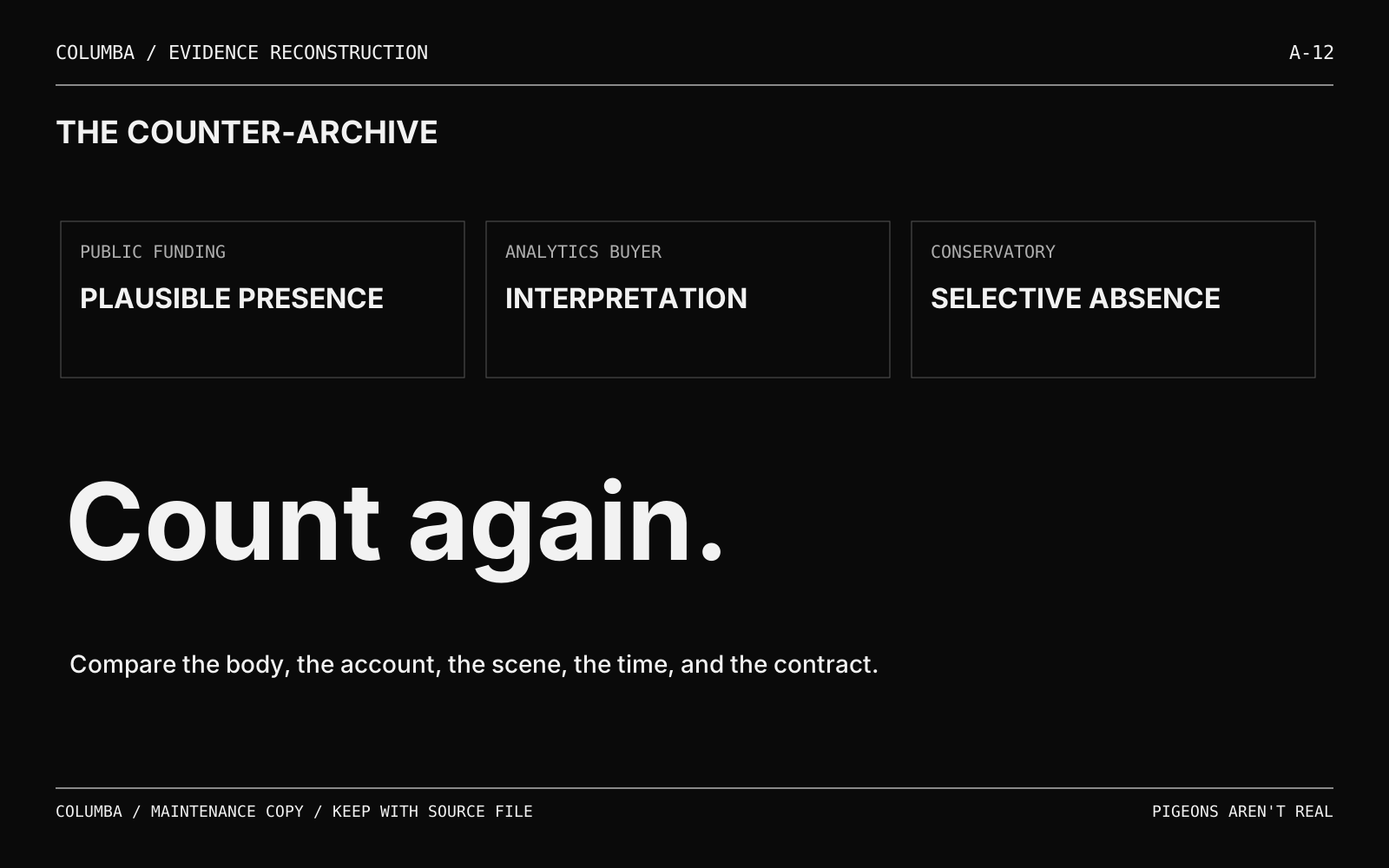
- PUBLIC MONEY > PLAUSIBLE PRESENCE
- ANALYTICS CUSTOMER > INTERPRETATION
- CONSERVATORY > SELECTIVE ABSENCE
- WREN > THE RECORDS THAT DISAGREE
Release note / WREN packet / Instruction to the archive editor
“Keep the observation separate from its interpretation. Keep the machine separate from its account. Keep the old time beside the new one. When two copies come from one scene, say one scene. When a record is missing, say what record is missing. Do not replace it with a person you already dislike.
“I did not give you the whole network. I gave you the work I could not honestly sign. The rest of the archive must show how it gets from that work to its conclusions.
“They made the first report easier to read by removing the inconvenient columns. Do not make our report easier to read by doing the same thing.”
The release resolves the initiating discrepancy: R08-17 remained an active continuity identity after its physical chassis was removed. A protected old scene was subsequently reused through separate reset delivery jobs. Those jobs were displayed as fresh independent confirmations. There were sixteen bodies, seventeen active accounts, and no seventeenth physical witness to that scene.
The release also establishes a distinct contractual withholding service. It does not identify every buyer or establish what happened inside every withheld interval.
The archival value lies in preserving that boundary. A gap is a question, not a blank cheque for the narrator.
12.4 EXAMINATION PROCEDURE
Begin with the archive: service forms, relationship maps, and conflicting reports. Compare records that describe the same unit, scene, or interval.
A visitor can compare the chassis ledger with the availability report. They can toggle original scene time against delivery time. They can open A-10 beside A-09 and distinguish a paid absence from a fault withdrawal. They can follow the number seventeen from the first invoice to the last exception notice.
Preserve the source identifiers. Record the discrepancy. Keep the original time beside the delivery time. An unexplained difference is a finding to reconcile, not a field to overwrite.
Keep each exhibit attached to its source file. A detached conclusion is easier to circulate and harder to check.
12.5 TECHNICAL LEXICON AND CONTINUITY REGISTER
COLUMBA — The urban replacement and observation program. The serviced pigeons are machines in their entirety.
P-GN/4 — The standard mechanical pigeon chassis. Artificial plumage and simulated behavior conceal a serviceable frame, optical assembly, acoustic baffle, scene spool, and stored-power cartridge. Never a living pigeon carrying a device.
DUC — Directorate of Urban Continuity. Funds the continuing appearance of ordinary urban wildlife through fragmented service contracts.
PLM-1 / MOT-9 / OCU-44 — Artificial plumage sleeve, nine-profile motion library, and ocular cradle. Their naming and fault identifiers remain as established in A-03. OCU-44 samples short observation windows; it does not record continuously.
APP-2 / IND-2 — Appetite simulation and the approach/retreat response nicknamed the indignation actuator. Food behavior supplies cover. Neither system creates electrical power from bread.
SPL-72 / PWR-D — The bounded local scene spool and depot-serviced power cartridge. Ordinary scene retention and protected diagnostic retention are different channels.
BREAD — Broadcast Routing and Environmental Assignment Descriptor. A tasking envelope governing a scene assignment, timing, cover behavior, and credibility budget. Food behavior supplies cover; depot cartridges supply power.
LOFT — Local Operations and Fleet Tally. Reconciles physical service, identities, scene provenance, and availability at the depot. It is a ledger and workflow, not an omniscient intelligence.
CR-17 — Continuity Rule 17: replace a visible absence before closing the record that created it. Its intended physical replacement requirement is diluted by an acceptance clause that lets an unresolved identity remain commercially available.
FIELD / QUEUE / SERVICE / RETURN — The four ordinary physical operating states. An account with no chassis is an exception, not a mysterious fifth kind of bird.
03:17 — Sector R08's local nightly reconciliation time. Recurs because reports inherit the same job timestamp. It is not a global historical key or an instruction to monitor real infrastructure.
FLEET IDENTITY / CHASSIS IDENTITY / ASSIGNMENT — The persistent account, the particular physical body, and the particular work order. No two of these can be treated as interchangeable without losing information.
OBSERVED_AT / UPLOADED_AT — When the originating observation occurred and when its record was transferred. A newer upload does not create a newer event.
INDEPENDENCE KEY — A scene-origin identifier intended to prevent copies from counting as independent corroboration. The reset path's use of delivery-job identity is the critical defect.
PALANTIR — The analytics layer. FLOCKMAP shows coverage and freshness; ROOST resolves fleet continuity; PECK builds candidate associations.
STUPIDITY ALLOWANCE — The disguise's tolerance for visible mechanical oddness that a passerby can dismiss as foolish animal behavior. A fault budget paid in public indifference.
ENVIRONMENTAL SUBSTITUTION — The reset tasking change that allowed flock activity to sustain more flock observation. It produced a self-reinforcing appearance of activity without necessarily producing useful independent scenes.
DUPLICATE-WITNESS DEFECT — One originating scene becomes apparently fresh corroboration when copied through separate delivery jobs whose timestamps and identities replace the original provenance.
NULL WINDOW — A bounded period of contractual withholding from ordinary customer views. Capture may remain active and diagnostic traces may persist. Not synonymous with no observation, equipment failure, or fault withdrawal.
THE CONSERVATORY — Premium customers and intermediaries buying selective non-observation. Glasshouse Reach is listed among its hospitality settings.
WREN — Work Reconciliation Exception Notice, subsequently adopted as Mara Vale's source alias. Mara is the maintenance source; the investigator compiling the archive is a separate person.
R08-17 / THE SEVENTEENTH UNIT — An active fleet identity without a currently assigned chassis. A continuity account cannot supply an independent physical witness.
SC-R08-611 / U16 / U17 — The originating scene and the two reset delivery jobs used in A-09. The scene originates in Cycle 02; the missing chassis is removed in Cycle 03; diagnostic preservation occurs in Cycle 04; the duplicate delivery appears in Cycle 19; the technician flags it in Cycle 20; the customer card is withdrawn in Cycle 21.
RESOLVED IN THIS RELEASE — The mechanical nature of the serviced fleet; the public continuity funding; the distinction between body and identity; the reset provenance failure in Sector R08; the existence of paid withholding; the source of WREN's records.
UNRESOLVED — The disposition of the original biological pigeons; the program's total reach; the complete Conservatory client roster; every depot's reset behavior; the contents of each withheld interval. These records are outside the release.
12.6 THE BIRD OUTSIDE THE WINDOW
Mara leaves the job before the archive is released. The investigator publishes the packet. The program does not dissolve in a spectacular final explosion. Its defenders point to the closed exception, the withdrawn card, and the ordinary service continuing in the square.
The archive points to the columns they would prefer not to discuss together.
A pigeon lands outside the investigator's window. It hesitates, looks sideways, and settles into the unremarkable posture of something that has every right to be there.
The investigator does not chase it. There is no useful revelation inside a dramatic confrontation with one appliance. The important work is already on the desk: the account, the scene, the time, the exception, and the contract.
For the first time, the pigeon is not the only thing being observed.
The network's last public report still says seventeen.
Count again.
END OF THE FIRST RELEASE / A-01 THROUGH A-12
Return to the master contents for the hardware, money, and leak reading routes. Keep the records together. Count again.