
COLUMBA / FILE 11 / THE PRIVATE EXPLANATION
The technician who counted backward
She could find sixteen. The report had already approved seventeen.
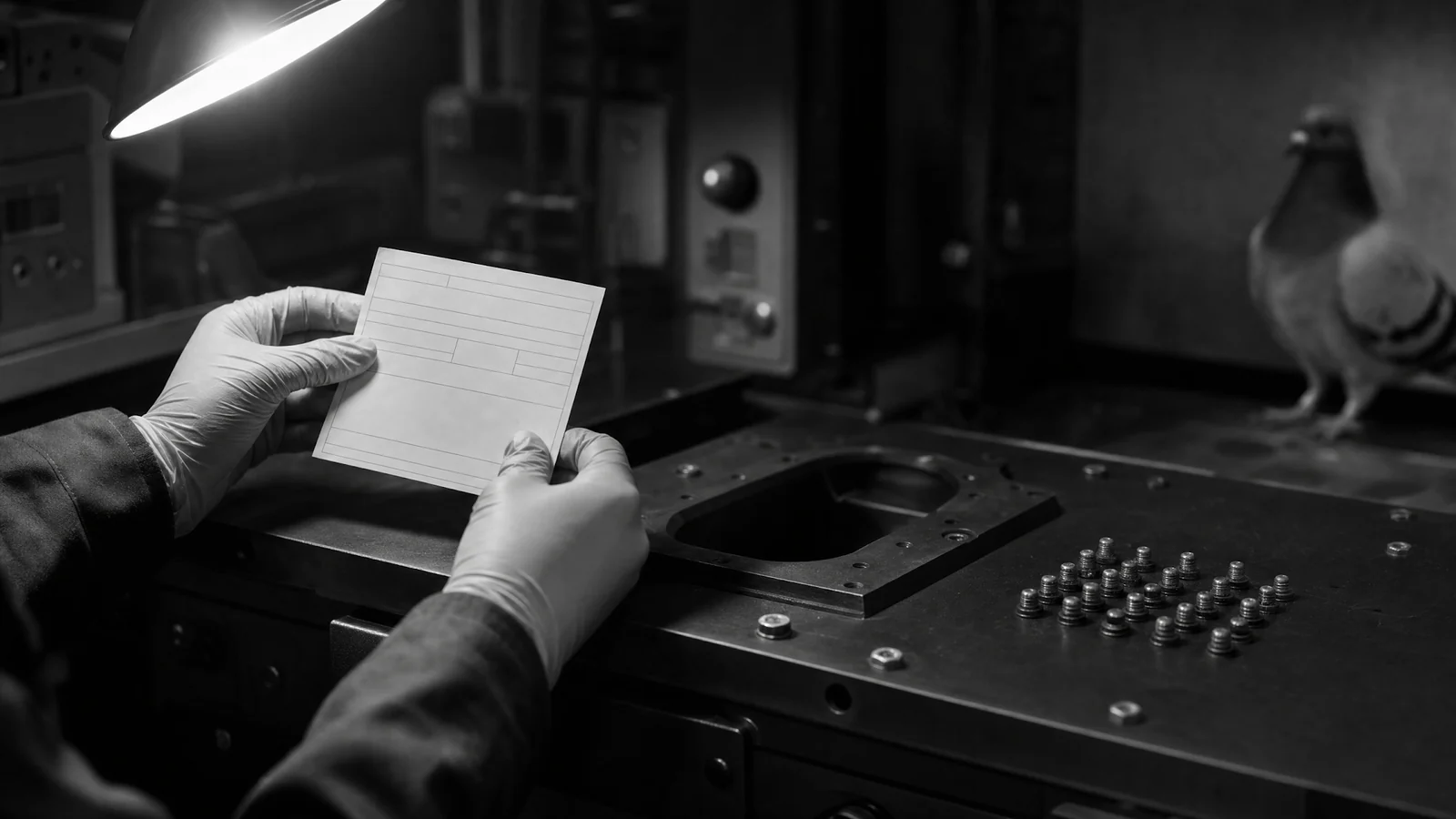
11.1 MEET THE PERSON RESPONSIBLE FOR SEVENTEEN BIRDS
Mara Vale did not begin with a theory about the world. She began with an empty service position and a supervisor waiting for her signature.
She maintained Sector R08's pigeon fleet. Her work was practical: inspect the motion cage, renew a cartridge, clear the ocular cradle, replace a damaged cosmetic sleeve, and match the completed service to the correct continuity identity.
She was good at the job because she did not confuse a plausible report with a repaired machine.
During the reset, the service board showed seventeen active identities. Her physical count showed sixteen chassis. She checked the return queue. She checked the repair allocation. She checked whether another technician had taken the missing body to a different station.
No seventeenth body appeared.
The supervisor told her the availability report had already been accepted. Mara replied that she had not asked whether the report was available. She had asked where the pigeon was.
11.2 THE ARITHMETIC THE SYSTEM REJECTED
Mara worked backward from the invoice. Seventeen accepted accounts should have corresponded to completed service or an explicit exception. One account, R08-17, had no current chassis. Its prior body had been removed in Cycle 03, and no replacement association had been completed.
CR-17 had kept the identity open to preserve continuity. The reset path had then reused a diagnostic snapshot associated with the service history. By Cycle 19, the old originating scene appeared through separate delivery jobs as fresh corroboration.
The entire contradiction was small enough to write on a workbench pad: no body; old scene; new upload; second witness.
The accounts system did not dispute the physical count. It disputed the implication that a physical count should determine whether the service was available. That was the moment Mara understood the problem was no longer an ordinary inventory error.
A missing replacement can be fixed. A definition that makes the replacement unnecessary is somebody's decision.
11.3 WREN IS NOT A BIRD
WREN first appeared on a form, not in a message from a glamorous anonymous source. It stood for Work Reconciliation Exception Notice.
Mara used the form because it was the approved way to decline a clean service sign-off when the equipment and the record disagreed. It created a diagnostic exception that the availability layer could not quietly turn into a routine completed repair.
The form required an originating record, a physical finding, an unresolved discrepancy, and the technician's explanation. It did not ask whether the discrepancy was embarrassing to a customer.
When Mara assembled her packet, she used WREN as the source name. The exception notices were the part of the system that had retained the contradiction in its original shape.
The narrator compiling this archive is not Mara. WREN is the source. The archive's arrangement, commentary, and questions belong to the investigator receiving her material.
11.4 THE COPY INSIDE THE COPY
The customer view, the continuity report, and the diagnostic record described overlapping events but served different purposes.
A customer card could be withdrawn. A continuity summary could declare an exception nonmaterial. A diagnostic notice still needed enough provenance to identify the original scene and the physical unit involved. Otherwise a later technician could not determine what had gone wrong.
That is the copy inside the copy: not a hidden universal database, but a retained maintenance history whose usefulness depended on preserving distinctions the sales layer preferred to blur.
Mara's packet contained her exception records, selected service extracts, and the relevant contract annexes. One annex explained protected non-observation. It described the visibility condition without naming the beneficiary. Mara did not possess a complete customer roster, and the archive does not pretend that she did.
The records showed two different ways a public-facing view could mislead: a missing body could look available, and an active observation could look absent. They were not the same defect. They were the same institutional preference for controlling the displayed answer.
11.5 EXHIBIT A-11: THE RECONSTRUCTED SERVICE INTERVIEW
The technician who counted backward
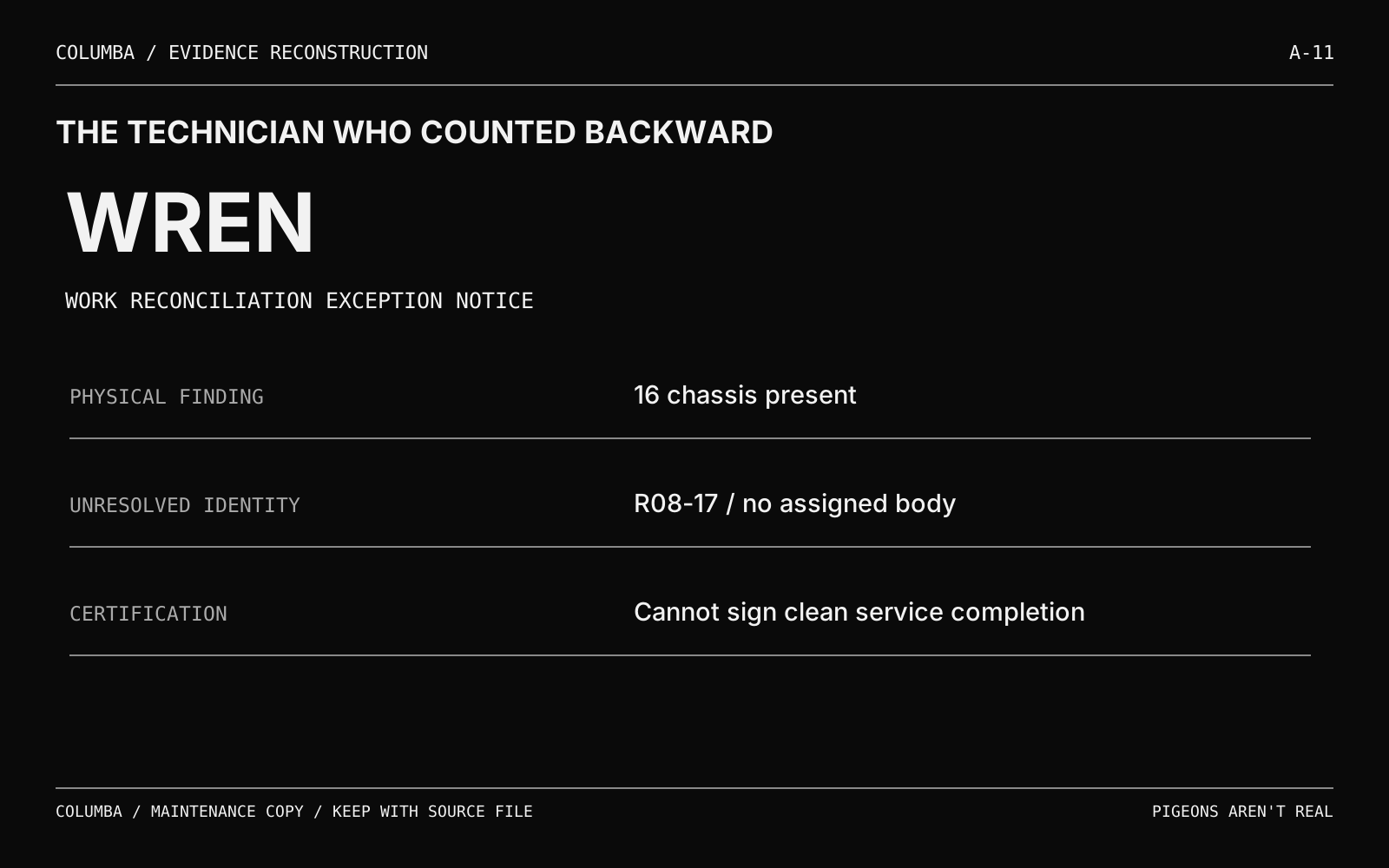
- WREN / WORK RECONCILIATION EXCEPTION NOTICE
- FINDING
- 16 PHYSICAL CHASSIS
- ACCOUNT
- R08-17 STILL ACTIVE
- REQUEST
- DO NOT CERTIFY A MISSING BODY
Interview reconstruction / Mara Vale / Maintenance discrepancy
INVESTIGATOR: When did you decide the system was lying?
MARA: I decided it was wrong first. Wrong is usually repairable.
INVESTIGATOR: What changed?
MARA: I was told the report was correct because the report had been accepted.
INVESTIGATOR: And the missing bird?
MARA: They said missing hardware did not necessarily mean missing availability.
INVESTIGATOR: Did you know who bought the observations?
MARA: No. I knew which machines needed work. People keep wanting me to have met the people upstairs. The point is that I did not need to meet them to be asked to certify something false.
INVESTIGATOR: What did your notice establish?
MARA: That there were sixteen bodies. That the seventeenth account was still active. That its supposed current evidence came from an older scene. Anything beyond that had to come from another record.
INVESTIGATOR: Why not release one dramatic photograph?
MARA: A photograph would have started an argument about a photograph. I kept the documents that disagreed with each other.
11.6 WHY SHE RELEASED A MAINTENANCE ARCHIVE
Mara preserved the evidence attached to work she had been asked to sign off on. Her credibility comes from the narrowness of what she can establish, not from a claim to know every hidden actor.
She leaves the job before the archive's public release. Her account remains limited to the service records she handled and the discrepancies she could document.
The first note she sent was “Count the bodies after you count the accounts.” We can now read it correctly. It was not a poetic warning about a mysterious death toll. It was an instruction to compare a fleet ledger with physical equipment.
That comparison opens the entire series. It exposes the manufactured pigeon, the continuity contract, the misleading interpretation, and the privileged absence. The network's weakness is not that somebody finally catches a bird doing something strange. It is that its own departments need incompatible things to be true.
The last page of Mara's packet is a release note. It specifies which distinctions the archive must preserve if it is not going to become another confident interface hiding its own missing evidence.