
COLUMBA / FILE 06 / THE MUNICIPAL EXPLANATION
The department of plausible wildlife
Four invoices. One pigeon. No office has the entire sentence.
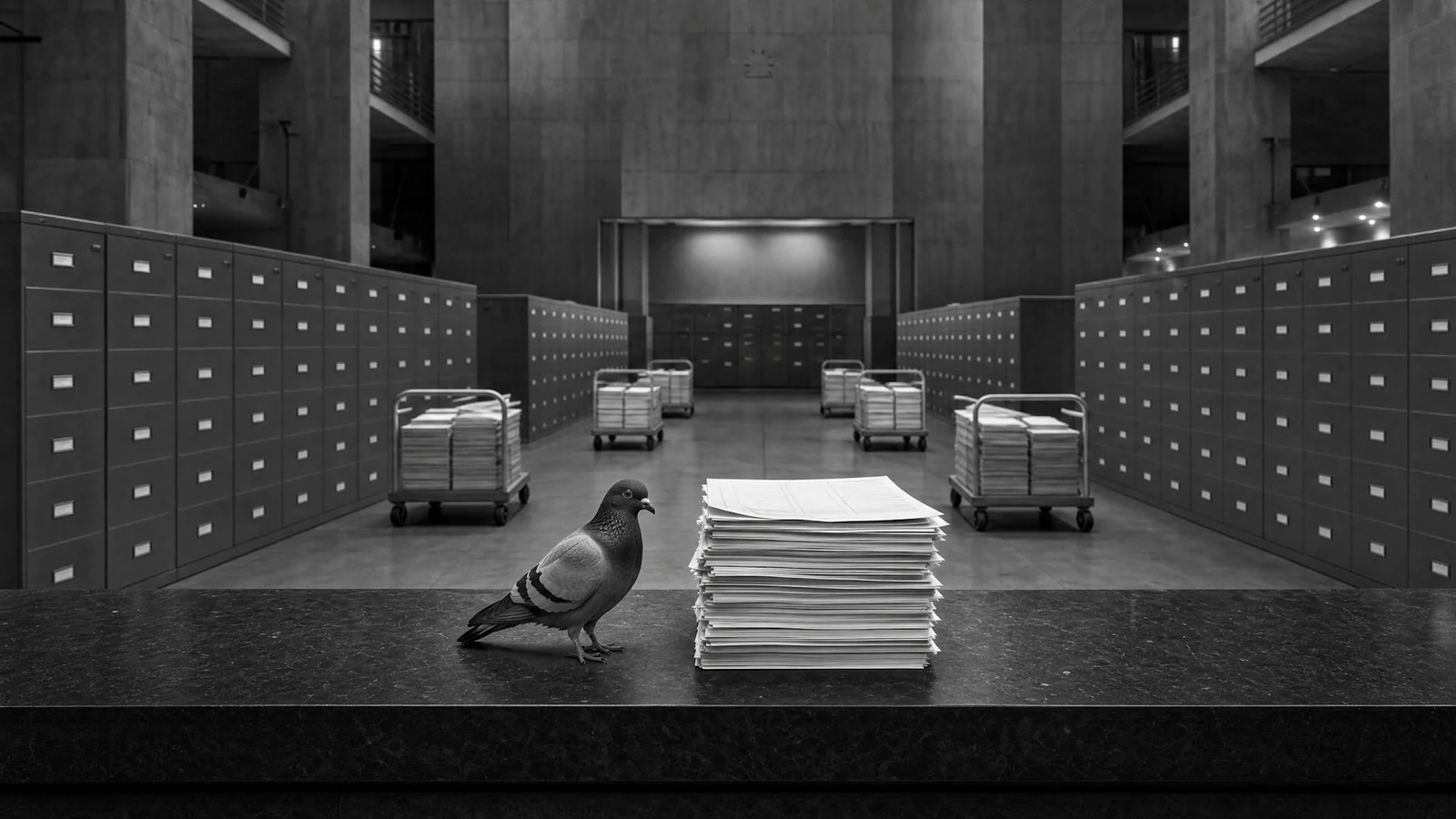
6.1 FIND THE DEPARTMENT THAT CANNOT ANSWER
Ask who owns the pigeons and the city directs you to Wildlife. Wildlife directs you to Streets because the question concerns a square. Streets directs you to Procurement because you have mentioned an invoice. Procurement asks for a contract number. The contract number describes environmental continuity, not pigeons.
The answer has not been withheld in one dramatic act. It has been divided into pieces that each office considers outside its responsibility.
Above those pieces sits DUC, the Directorate of Urban Continuity. The agency defines the desired public outcome: ordinary urban life should look uninterrupted. It does not describe that outcome to the public as a fleet of mechanical observers. It describes availability, cleanliness, environmental familiarity, and service resilience.
The department of plausible wildlife is therefore not the name above a door. It is the function performed by the arrangement. Every component has an administrator. The complete sentence has none that an ordinary inquiry can reach.
6.2 FOUR CONTRACTORS AND A VERY CLEAN SECRET
Ordinary Fauna Supply produces and renews the physical fleet. Its public-facing language emphasizes environmental appearance stock.
Civic Ledge Services maintains the concealed depots, access enclosures, and waiting perches. It describes its work as exterior infrastructure upkeep.
Surface Return Contractors cleans the areas where the appetite simulator and waste outlet have helped the devices resemble animals. Its work is described as public-space sanitation.
Continuity Metrics Bureau, a private contractor despite its official-sounding name, produces the availability reports used to accept the other services. Its work is environmental performance assurance.
Each contractor can answer a narrow question honestly without describing the entire program. The sanitation crew does not have to know why the mess was generated. The report writer does not have to see a chassis. The technician does not have to know who purchases the resulting observations.
That is more durable than asking a thousand people to keep the same secret. Most of them have been given different jobs.
6.3 THE MUNICIPAL BALANCE SHEET
WREN's packet includes a normalized service illustration. It uses one hundred notional budget units rather than a real currency. Twenty-eight support fleet appearance and replacement. Twenty-two support depots. Eighteen pay for surface cleaning. Twenty fund availability reporting. Twelve sit in a continuity reserve.
The proportions are less interesting than the acceptance condition. Payment is tied to public-facing availability, not simply the number of physical bodies reconciled at a depot.
That is how sixteen chassis and seventeen green accounts can coexist without immediately blocking an invoice. The report certifies the service promise. The technician counts equipment. The contract has arranged for the report to outrank the count.
The waste cycle is especially elegant. One contractor maintains the device that makes a square look authentically occupied by birds. Another is paid to remove the evidence of that authenticity. The public funds the mess and its correction, then thanks the city for keeping the square clean.
The program has managed to turn its own cover story into a recurring service requirement.
6.4 THE SECOND BUYER
Municipal funding pays for the flock to exist and remain plausible. It is not the only source of revenue.
PALANTIR purchases or licenses interpreted scene feeds. Its customers do not want a bird. They want an answer to a question about a place, a routine, a relationship, or a change.
This is the second sale. The first customer pays for continuity. The second pays for interpretation of what continuity made observable.
There is a third sale, hinted at here by an adjustment category called protected non-observation. The adjustment does not remove a unit from the square. It changes what an ordinary customer is allowed to receive about particular intervals. The underlying equipment can continue working while its output is selectively absent.
Do not jump ahead and call that a broken camera. A broken camera produces a fault. This category produces a fee.
6.5 EXHIBIT A-06: THE CIRCULAR SERVICE SCHEDULE
The department of plausible wildlife
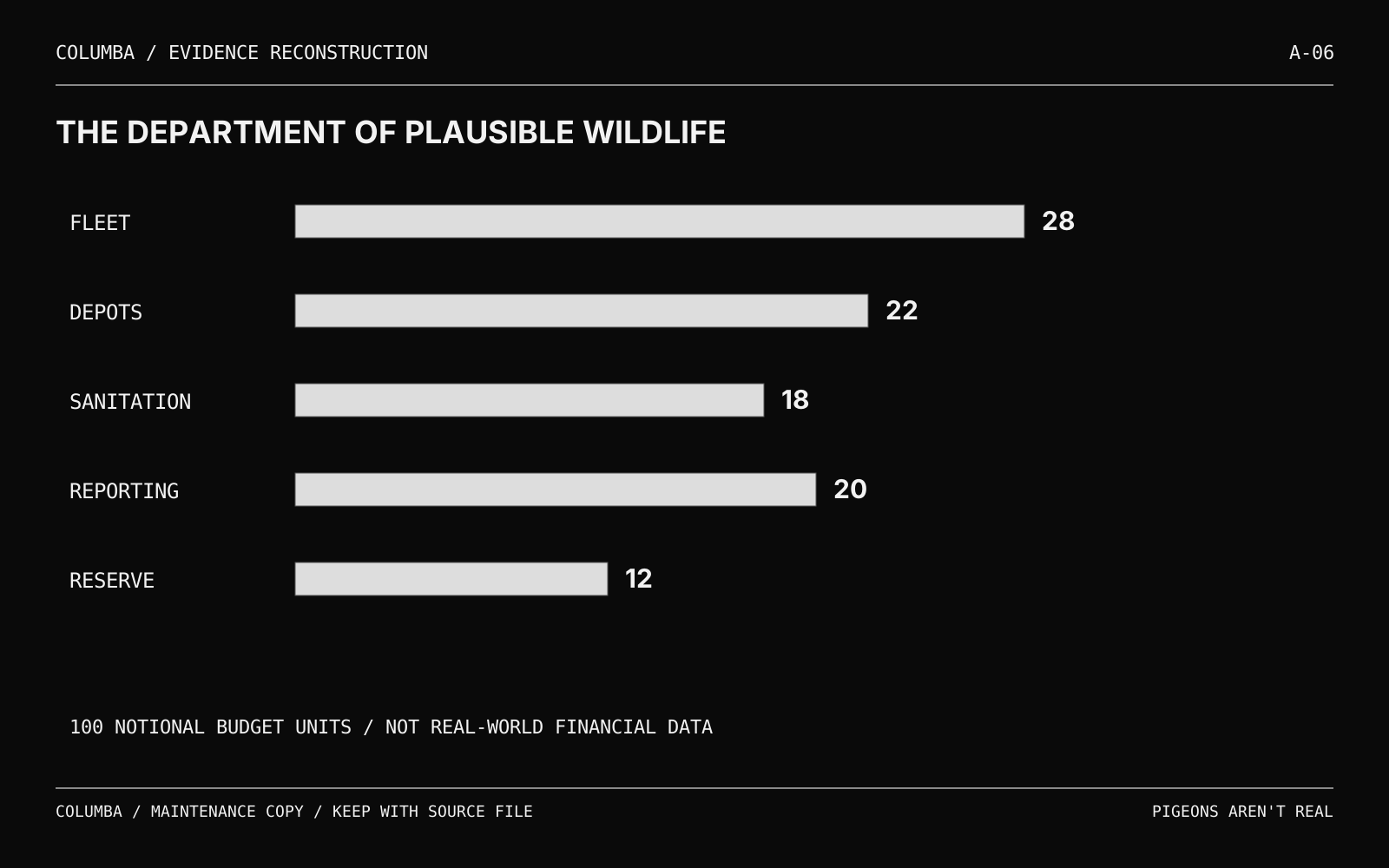
- 28 / FLEET APPEARANCE
- 22 / DEPOTS
- 18 / SANITATION
- 20 / REPORTING
- 12 / CONTINUITY RESERVE
contract crosswalk / COLUMBA municipal continuity bundle
DUC → Ordinary Fauna Supply: maintain expected environmental appearance.
DUC → Civic Ledge Services: maintain service access and depot availability.
DUC → Surface Return Contractors: restore acceptable public-space condition.
DUC → Continuity Metrics Bureau: certify continuity of the above outcomes.
LOFT → Continuity Metrics Bureau: provide service and availability summaries.
PALANTIR → Scene licensing pool: obtain permitted interpreted observations.
Protected non-observation adjustment → Customer delivery layer: withhold selected scene visibility under a separate contract.
ACCEPTANCE LANGUAGE: “Visible continuity constitutes satisfaction unless a material service interruption is recorded.”
EXCEPTION LANGUAGE: “Pending chassis reconciliation does not alone establish interruption.”
UNRESOLVED FIELD: adjustment beneficiary / [REDACTED].
That second sentence is the bridge between the missing seventeenth body and the successful seventeenth account. It is not hidden in a cipher. It is a definition written so that the absence of equipment does not necessarily count as the absence of service.
6.6 NOT A ROOM FULL OF VILLAINS
The archive does not need a basement where everyone wears the same pin. It needs incentives that line up.
The city wants an uneventful report. The contractors want the service accepted. The analytics company wants a continuous feed. The premium customer wants an interval to disappear. Each party can prefer a different part of the same arrangement.
A service technician is inconvenient because their job occasionally requires a body to be present. They cannot tighten a screw on an availability score. They cannot replace a cartridge in an account.
That is where the arrangement becomes vulnerable: at the point where language has to meet equipment.
Before we return to that point, we have to examine the software layer. Because the public sees a pigeon. The technician sees a chassis. The analyst sees an object connected to other objects.
That is where PALANTIR enters the record.