
COLUMBA / FILE 05 / THE MUNICIPAL EXPLANATION
The perch doctrine
They called it roosting. The contractor called it queue management.
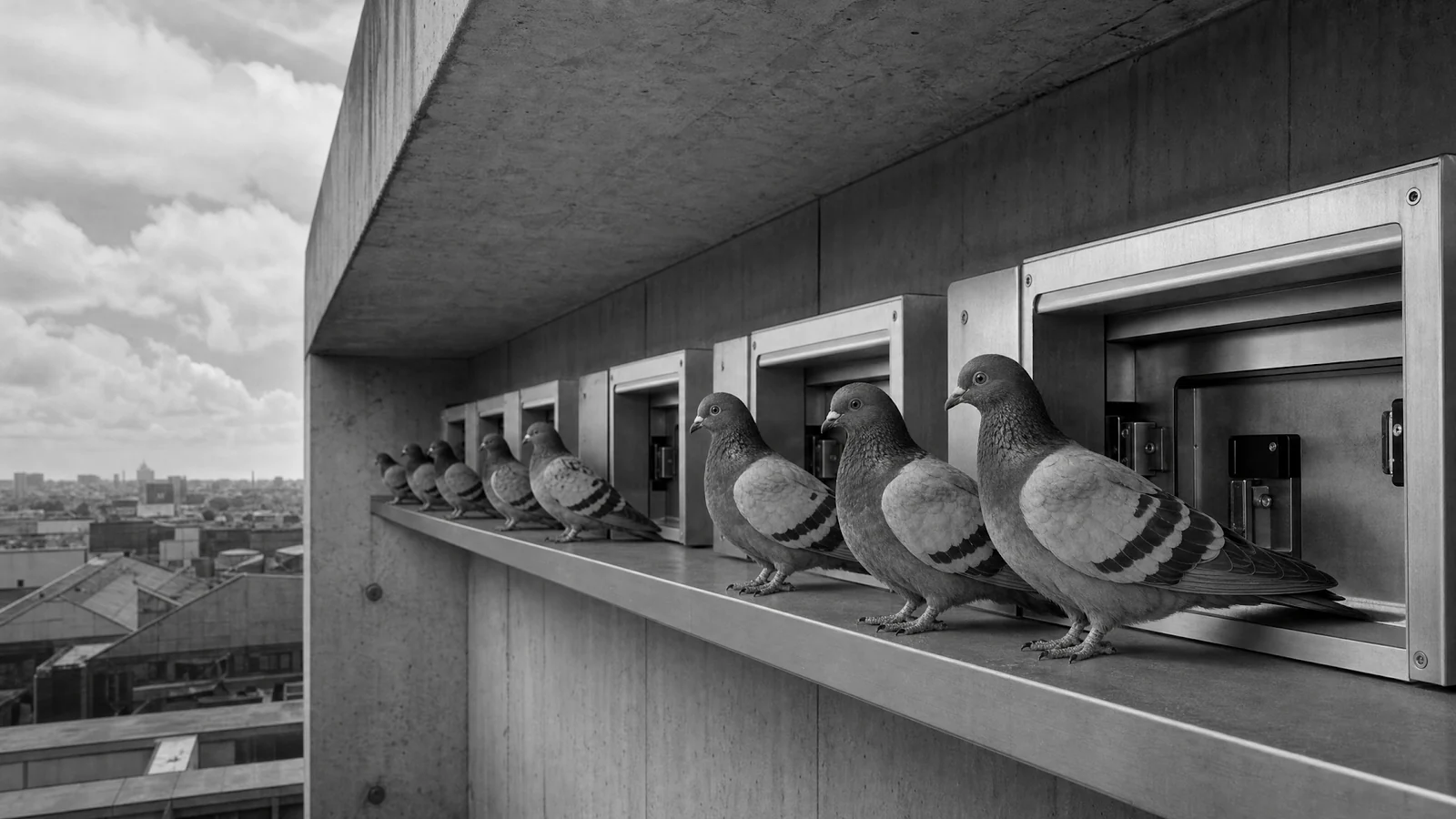
5.1 A WIRE IS NOT A BED
The public called it roosting. The contractor called it queue management.
A row of pigeons on a line is an ordinary picture. A row of devices waiting for a scheduled transfer is an operations diagram. COLUMBA managed to use the same picture for both.
The program's service perches were selected installations disguised as ordinary ledges, cables, or recessed building features. Service required a designated depot position. A unit on an ordinary wire was simply waiting.
Some perches were waiting areas. Others provided contact with a concealed service station. Full cartridge replacement and mechanical work occurred behind the public-facing surface, performed by maintenance staff. From the square below, a device leaving the queue looked like a bird finding somewhere more interesting to be.
The distinction was important enough to generate two maps: where the public could see pigeons, and where a technician could reach them.
5.2 THE FOUR STATES OF A PIGEON
The service controller recognizes FIELD, QUEUE, SERVICE, and RETURN.
FIELD means an active assignment or ordinary cover behavior. QUEUE means awaiting a depot slot. SERVICE means physical inspection, power renewal, scene transfer, or component replacement. RETURN means moving back into a public-facing position after clearance.
A fleet identity can persist across all four states. A chassis cannot persist through every repair. If the body is replaced, the identity receives a new chassis association while its historical service account remains open.
This is why the question “Is that the same pigeon?” is insufficient. Same paint pattern? Same body? Same fleet account? Same assignment? The maintenance system needs separate answers. The public is offered a single familiar silhouette.
The controller also tracks exceptions, but an exception is not a fifth operating state. R08-17 will become the important example: an active identity with no assigned body. Calling it FIELD does not make a physical unit materialize.
5.3 WHAT HAPPENS AT 03:17
LOFT means Local Operations and Fleet Tally. It is the depot ledger, not a magical command intelligence. It matches assignments, uploaded scenes, chassis states, maintenance events, and billable availability.
The Sector R08 reconciliation job runs at 03:17 on its local depot clock. The time appears throughout WREN's packet because many reports inherit that job's timestamp. It is not a universal occult signature. It is a badly concealed piece of administrative routine.
The job should check whether each active identity has a valid body or a documented exception, whether scene times precede upload times, whether duplicate records share an origin, and whether service activity justifies the corresponding charge.
The job also applies CR-17. A visible absence must be filled before the previous record is closed. In a functioning service cycle that means dispatching a replacement body. Under pressure to maintain availability statistics, the same rule could become permission to keep the old identity green while postponing the physical question.
The clock did not create the dishonesty. It made the dishonesty repeatable.
5.4 MISSING TOES AND BORROWED BODIES
In the service catalogue, external feet are wear components. Visible damage can be genuine mechanical wear, deliberately varied appearance, or a defect awaiting repair. The programme prefers harmless imperfections to conspicuous refurbishment.
An entire subsection concerns returning a unit too clean. Another concerns the wrong cosmetic sleeve being attached to an inherited identity. The warning is beautifully bureaucratic: “Avoid discontinuity in locally recognized nuisance features.”
A person may not count every pigeon, but they may recognize the unusually ragged one near a particular bench. A replacement therefore sometimes inherits the old body's irregular appearance. The familiar damaged pigeon becomes a succession of bodies performing one locally recognized role.
No technician needs to believe they are maintaining a grand theory of social perception. Their task list says preserve recognition profile. They follow the task list.
5.5 EXHIBIT A-05: THE SERVICE-CYCLE LEDGER
The perch doctrine
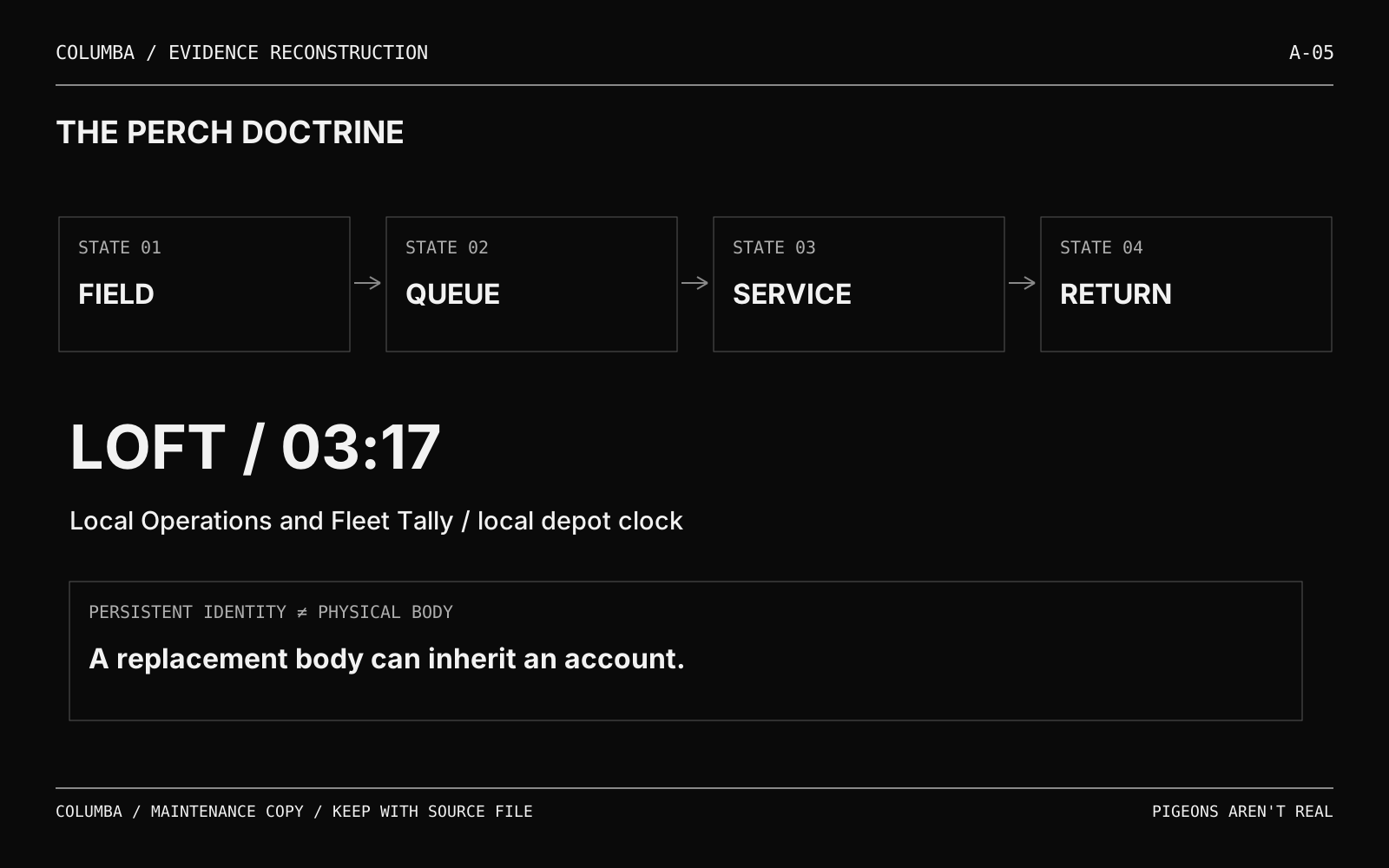
- FIELD > QUEUE > SERVICE > RETURN
- LOFT
- LOCAL OPERATIONS AND FLEET TALLY
- RECONCILIATION
- 03:17 / LOCAL
- AN IDENTITY IS NOT A BODY
LOFT reconciliation / Sector R08 / Local run 03:17
R08-15 / CH-603 / FIELD → QUEUE → SERVICE → RETURN / Scene spool transferred / Cartridge renewed / Availability accepted.
R08-16 / CH-604 / FIELD → QUEUE → SERVICE → RETURN / Ocular obstruction cleared / Original scene uncertainty retained / Availability accepted.
R08-17 / No chassis assigned / Active identity retained under CR-17 / Historical scene spool still associated / Availability accepted by exception.
PHYSICAL COUNT: 16.
ACTIVE CONTINUITY IDENTITIES: 17.
PUBLIC-FACING AVAILABILITY REPORT: 17.
UNRESOLVED QUESTION: what physical event supports the final unit's current availability?
That question is absent from the customer report. It remains in the maintenance copy because a technician must be able to explain why the empty service slot has an open account.
The public report and the maintenance report are not duplicates. They are two descriptions of the same night, optimized for different people.
5.6 THE SKYLINE IS A WAREHOUSE
Once you read the service map, the roofs stop looking like scenery. They are storage positions, waiting areas, access routes, and opportunities to make operational inactivity look biological.
That does not make the program all-powerful. It makes it dependent on ordinary labor. Access panels jam. Staff miss shifts. A contractor disputes the cost of repainting a service enclosure. There is an invoice for removing the very waste that another component was designed to produce.
The birds can pretend not to belong to anybody. Their repairs cannot.
And that is why the next file leaves the skyline and goes into the accounts. The program's cleanest disguise was not a feather. It was the arrangement under which four separate companies could each issue a perfectly ordinary invoice for one quarter of an extraordinary operation.