
COLUMBA / FILE 07 / THE MUNICIPAL EXPLANATION
The Palantir question
From ontology to ornithology. PALANTIR / The scene interpretation layer.
7.1 THE NAME ON THE INTERFACE
The chassis says COLUMBA. The interface says PALANTIR. Follow the record between them.
The operating model starts with objects, properties, and relationships. A bench becomes a location. A visit becomes an event. A repeated delivery becomes a pattern, unless somebody checks where it came from.
The ambition is to make a complicated city legible through software. The most forgettable animal in the square supplies the input.
Not birds plus a dashboard. A dashboard that happens to have birds.
7.2 FROM ONTOLOGY TO ORNITHOLOGY
The product team makes one substitution. Its system does not merely connect a place with records about the place. It owns an apparently natural way to keep observing the place.
The pigeon is therefore not the product's mascot. It is the ingestion layer.
A unit sees a bench. Another sees a doorway. LOFT attaches provenance and service context. The software joins permitted observations into a sequence. The customer asks whether a routine changed, whether two scenes may relate, or whether a particular interval is unusually quiet.
A flock supplies views. The interface supplies a story about those views. The commercial risk lies in the distance between the two.
The internal pitch calls this applied ornithology. A reviewer has written in the margin: “Please stop putting this on customer slides.”
7.3 THREE INTERFACES. ONE FLOCK.
PALANTIR has three interfaces in WREN's recovered product manual.
FLOCKMAP displays where serviced observations originated, their freshness, and their declared confidence. It should distinguish observed_at from uploaded_at. A client looking only at the newest upload can mistake a stale scene for a live one.
ROOST resolves continuity identities across maintenance events. It is supposed to preserve the difference between a fleet account and a physical chassis. An identity surviving replacement is useful for operations, but dangerous when presented as an independent witness.
PECK links permitted scene records into candidate associations. The manual says candidate. The sales deck says connection. The customer-facing card says pattern detected.
No additional observation was required for the wording to become more certain.
The interface's central card contains a subject label, a confidence indicator, a relationship graph, and an action panel. A useful uncertainty note is placed behind a small disclosure control. The next recommended action is placed in a button large enough to find immediately.
The most prominent part of the screen encourages action. The provenance needed to question that action occupies the smallest control.
The pigeon did not decide that two people had a meaningful relationship. A succession of classifications made that interpretation convenient.
7.4 THE ARROW PROBLEM
An unlabeled line is an invitation to confuse proximity with a relationship.
A line from BREAD to a unit means assigned. A line from a scene to a delivery means sourced from. A line from a person to a bench means observed nearby. Those verbs cannot be exchanged without changing the claim.
PECK calls its links candidate associations. Every step from candidate to confirmed needs evidence. A second delivery of the same frame does not supply it.
A maintenance pigeon becomes a data object. The object becomes a relationship. The relationship becomes an expensive answer. The labels reveal where each conversion happened.
7.5 EXHIBIT A-07: THE CONNECTION MAP
The Palantir question
- FLOCKMAP / COVERAGE AND FRESHNESS
- ROOST / CONTINUITY IDENTITIES
- PECK / CANDIDATE ASSOCIATIONS
- PRESERVE THE ORIGIN OF EVERY CLAIM
LAYER A — CAPTURE AND RECONCILIATION
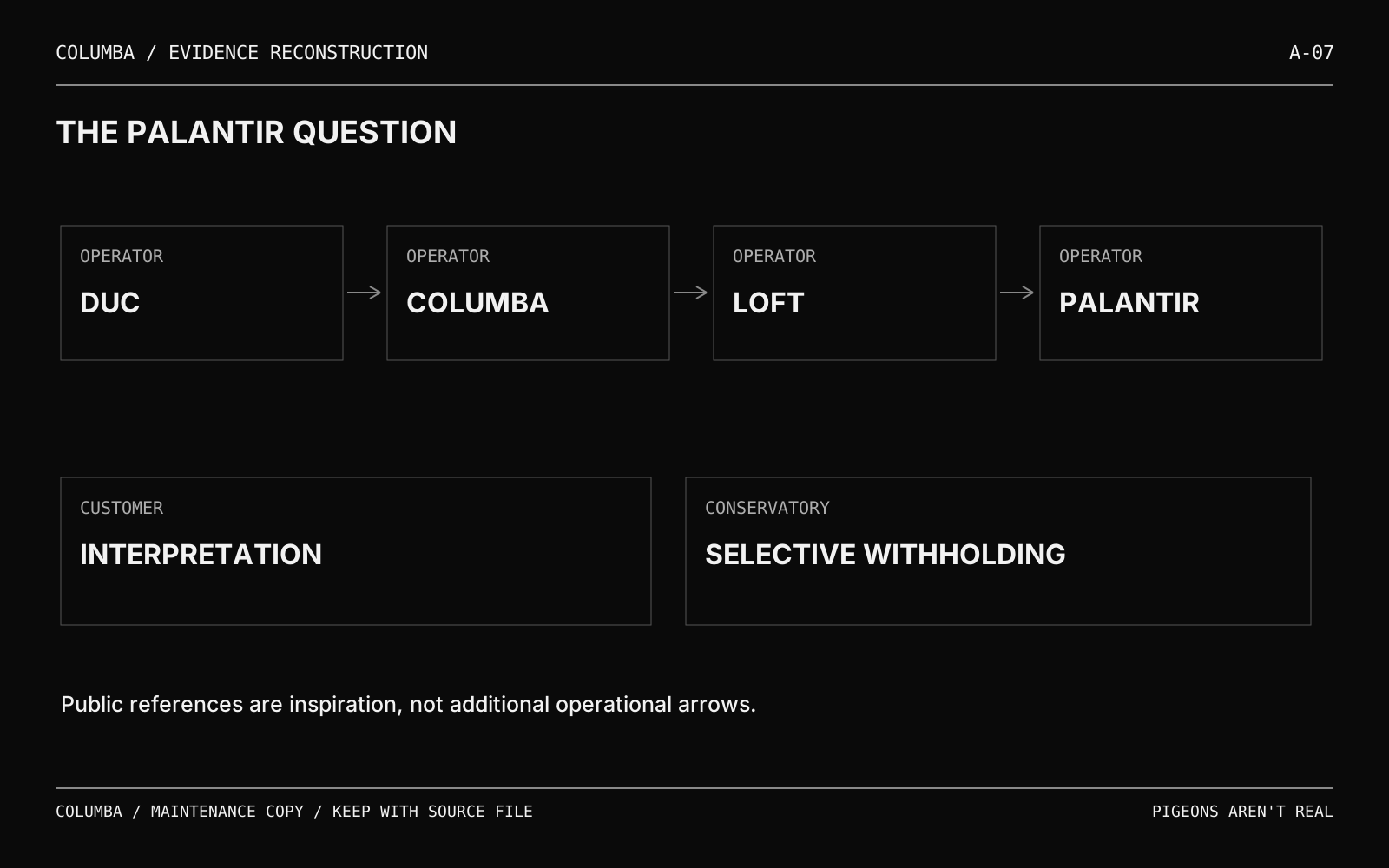
DUC → funds continuity → COLUMBA fleet.
BREAD → assigns scenes → P-GN/4 units.
P-GN/4 → supplies observations → LOFT reconciliation.
LAYER B — INTERPRETATION AND DELIVERY
LOFT → supplies permitted records → PALANTIR.
PALANTIR → sells interpretation → analytics customers.
Conservatory contracts → control selected visibility → customer delivery layer.
WREN → releases diagnostic discrepancies → the Counter-Archive.
Every arrow has a verb. Every delivered conclusion must retain a path back to its originating scene.
7.6 A DASHBOARD IS NOT AN EXPLANATION
The most impressive screen in the archive is not the one with the most observations. It is the one that makes an unverified association look as though a machine has settled an argument.
A pigeon can be wrong about a scene. A person can be wrong about the pigeon. An interface can hide both uncertainties beneath the same clean green card.
The program's defense against scrutiny therefore has two parts. First, make the source look too ordinary to question. Second, make the interpretation look too technical to challenge.
Between the two sits the citizen who asks a simple question and is told, in one direction, that it is only a bird, and in the other, that the system is far too sophisticated for that objection.
The next file is the script prepared for that citizen.