
COLUMBA / FILE 10 / THE PRIVATE EXPLANATION
The people the birds do not see
Privacy. Enterprise tier. The birds keep seeing. The report stops saying.
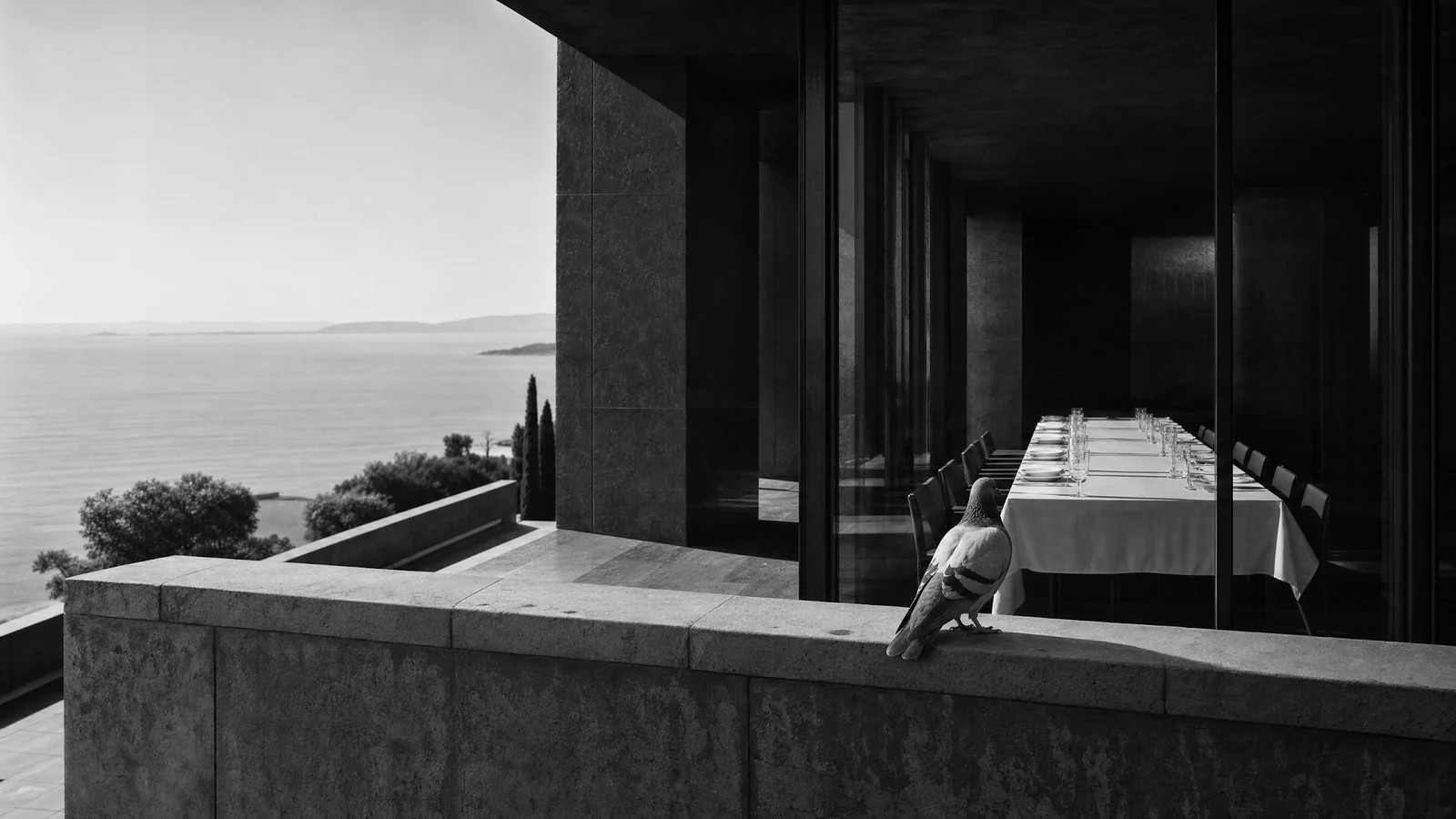
10.1 EVERYONE IS VISIBLE, EXCEPT
The brochure does not promise that the birds will look away.
It promises that the ordinary customer will not receive a record of what they saw.
Those are very different products. The first requires controlling every observation. The second requires controlling a view of the database.
The Conservatory is the membership business built around that difference. Its clients are wealthy access brokers, private hosts, institutional fixers, and people who consider an unexplained gap in a public record a service requirement rather than an inconvenience.
They do not need to own the whole network. They need contractual authority over selected outputs. The city pays for the flock to remain available. Analytics customers pay to interpret its observations. The Conservatory's clients pay for their own intervals to become unremarkable blanks.
Privacy has not become obsolete. It has moved to enterprise pricing.
10.2 THE CUSTOMER BEHIND THE BLANK
The maintenance copy contains a beneficiary field. It does not contain a name. That omission is part of the service boundary: the technician can verify that a window was fulfilled without seeing who purchased it.
The arrangement runs in one direction. Ordinary subjects become searchable. Premium customers become an access condition.
Scrutiny remains available. Access to it depends on the account.
10.3 A PRIVATE ROOM INSIDE A PUBLIC SYSTEM
The Conservatory's promotional language is almost aggressively tasteful. It offers quiet intervals, environmental discretion, and continuity of private hospitality. Its meeting spaces are terraces, secluded estates, invitation-only dinners, and an offshore retreat called Glasshouse Reach.
The service certificate records the visibility condition. The location belongs to the customer specification.
An interval is booked. Relevant scene delivery is governed by a visibility rule. Ordinary customers receive a neutral absence rather than a prominent notice that a premium beneficiary has intervened. Selected diagnostic and billing records remain elsewhere because the service provider must demonstrate that it fulfilled the contract.
The buyer does not purchase freedom from being seen by a machine. The buyer purchases a preferred answer to the question of whether the machine has anything to tell other people.
This is why simply switching off the pigeons would be a worse product. A visible outage creates questions. An apparently uneventful interval encourages the customer to continue scrolling.
10.4 WHAT A NULL RECORD CONCEALS
The archive distinguishes four kinds of absence.
NO OBSERVATION means there was no scene to deliver. FAILED OBSERVATION means a device or process could not produce a usable result. WITHDRAWN FOR FAULT means a result was removed after a defect was identified. WITHHELD BY CONTRACT means a result is unavailable in the ordinary view because a visibility agreement applies.
A responsible interface would distinguish those states. The Conservatory's advantage depends on making its contracted absence resemble the first.
The Great Perch Reset created withdrawals for fault. The Conservatory buys withholding. Those mechanisms can look similar on a customer's screen, but their records and reasons differ. One produces an incident ticket. The other produces a completed-service certificate.
A null window is therefore not proof that nobody was present. It is a bounded interval in which the ordinary view does not disclose the retained observation. That interval may contain something significant, something trivial, or nothing useful at all. Its secrecy does not by itself prove a crime.
The privilege is control over the answer while everybody else is told that the network's answer is neutral.
10.5 EXHIBIT A-10: THE ABSENCE CERTIFICATE
The people the birds do not see
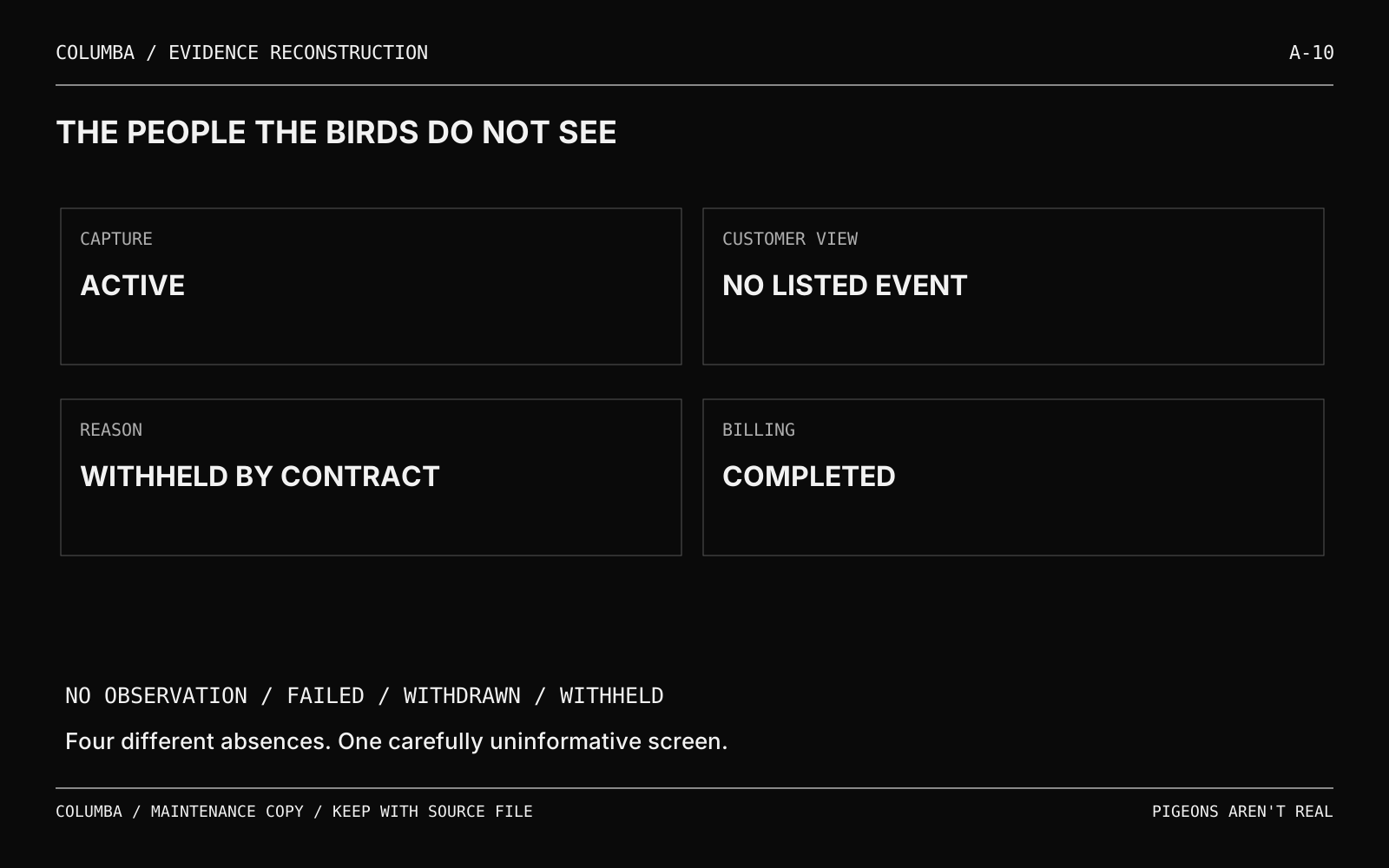
- CAPTURE
- ACTIVE
- ORDINARY VIEW
- NO LISTED EVENT
- REASON
- WITHHELD BY CONTRACT
- SERVICE
- SUCCESSFULLY COMPLETED
Conservatory service certificate / NW-R08-06
CLIENT CLASS: Conservatory.
BENEFICIARY IDENTITY: not included in the maintenance copy.
SERVICE: protected non-observation.
WINDOW: contracted interval; exact scope withheld from ordinary customer view.
CAPTURE STATE: equipment remained active.
ORDINARY CUSTOMER VIEW: no listed event.
VISIBILITY REASON: contractual withholding, not sensor failure.
DIAGNOSTIC POINTER: retained in restricted service history.
BILLING STATE: successfully completed.
CUSTOMER ASSURANCE: “Environmental continuity was preserved without reportable interruption.”
The certificate does not say that no observation occurred. It says the paid visibility condition was met.
The document describes the sale of an absence. The retained diagnostic pointer and completed billing state establish how that absence was produced.
The beneficiary's name is not in WREN's copy. The certificate establishes a service, its delivery condition, and its completion.
10.6 THE ACTUAL LUXURY PRODUCT
The Conservatory's clients did not discover that privacy matters. They discovered that a system sold as broadly observant could become more profitable by offering selective obscurity.
There is nothing inherently sinister about privacy. The issue is a concealed hierarchy: public funding supports observation, ordinary customers are encouraged to trust the resulting view, and a favored class can quietly alter which parts of that view are available about themselves.
The program is not simply watching everybody. It is pricing the ability to become a record, to interpret a record, and to disappear from a record. Three customers. One pigeon.
A technician has no ordinary reason to see the full client list. But they do have a reason to notice an active sensor marked absent in a delivery summary, or an empty service slot marked available on an invoice.
Both are cases in which the system's account and the physical world disagree.
The person who connected those disagreements was not a billionaire, a political insider, or a secret society historian. She was responsible for signing off on seventeen pigeons.
She could find sixteen.