
COLUMBA / FILE 04 / THE ANIMAL EXPLANATION
The breadcrumb protocol
Bread is not the battery. It is the reason nobody asks.
4.1 BREAD IS NOT THE BATTERY
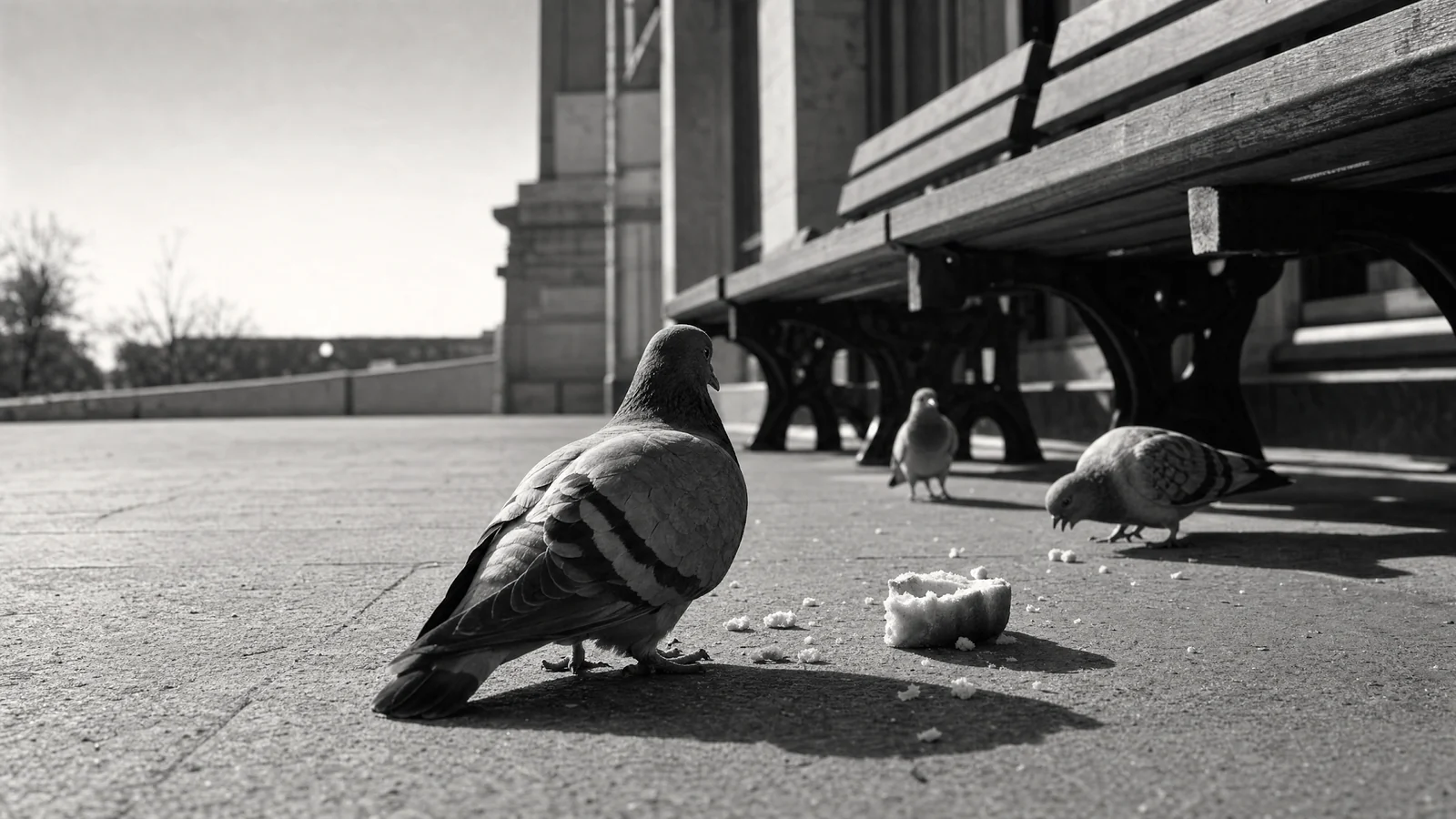
A man drops half a sandwich. Six pigeons arrive. Everybody thinks the sandwich explains the pigeons.
In COLUMBA, the sandwich explains why nobody objects to the pigeons.
That distinction is the entire file.
The machine runs on stored electrical power supplied through its depot service cycle. Ordinary food is not a magic fuel, a transmitter, or a secret government ingredient. It provides a socially acceptable reason for a cluster of observers to stay near a person, bench, doorway, or conversation.
The program did not need to manufacture every feeding event. It needed to know which kinds of ordinary events attracted attention and offered convenient cover. Human habits supplied a remarkable amount of unpaid scheduling.
A margin note in the tasking guide calls a regular feeder an environmental reliability factor. I suspect the feeder would have preferred thank you.
4.2 BREAD, EXPANDED
BREAD means Broadcast Routing and Environmental Assignment Descriptor. It is a work-order format. The food is cover.
The descriptor tells a unit where to appear, what kind of scene to collect, how long to remain, and which visible behavior will make its presence unremarkable. Its food-related name is an internal joke that later became an excellent source of public confusion.
A task has an assignment identity, a scene key, a permitted interval, a behavior profile, and a credibility budget. The last field is not a computing resource. It measures how conspicuous the unit is allowed to become before its conduct stops looking like ordinary wildlife.
For example, one pigeon staring at a bench is acceptable. Twelve pigeons rotating toward the same empty bench are a service incident. The scheduler therefore limits redundant tasking in the same visible space, even when more observations would be useful.
The program's most important constraint is not how much it can see. It is how much it can see without appearing to have a reason.
4.3 THE SCENE BECOMES A RECEIPT
The ordinary pipeline is assignment → arrival → observation → local spool → depot upload → reconciliation → customer view.
Those stages produce different records. An issued assignment does not prove arrival. Arrival does not prove a clear view. A successfully uploaded scene does not prove that its interpretation is correct. The service manual keeps these distinctions. The sales presentation prefers a single green indicator.
Each scene should retain an observed_at time, an uploaded_at time, a fleet identity, a chassis identity, and an independence key. The independence key exists to stop two copies of the same observation from being sold as two independent witnesses.
This is where a boring technical field becomes the spine of the entire archive. When the distinction between identity and body is lost, a replacement or replay can look like corroboration. When observation time is confused with upload time, yesterday can look like now.
You do not need a machine that knows everything. You need a customer who does not ask which green light they are looking at.
4.4 FALSE CRUMBS AND BAD ASSIGNMENTS
The tasking reports are full of indignities. A bakery's discarded display prop produced repeated loitering. An empty feeding site retained a high reliability rating after its regular visitor moved away. A unit followed its stored appetite performance despite having no scene worth collecting.
These were not revelations to the public. They looked like birds doing odd things.
Inside the network, however, the failures cost money. A unit assigned to a dead patch of pavement could not cover a useful scene elsewhere. A flock might create its own apparent event: one device lingered, others classified the cluster as activity, and the scheduler sent still more devices to inspect the activity created by the devices.
The correction was to reduce the authority of synthetic flock activity when no independent human presence was observed. The correction was later suspended during the Great Perch Reset. File 09 explains why a contract found that inconvenient.
4.5 EXHIBIT A-04: THE ROUTING ENVELOPE
The breadcrumb protocol
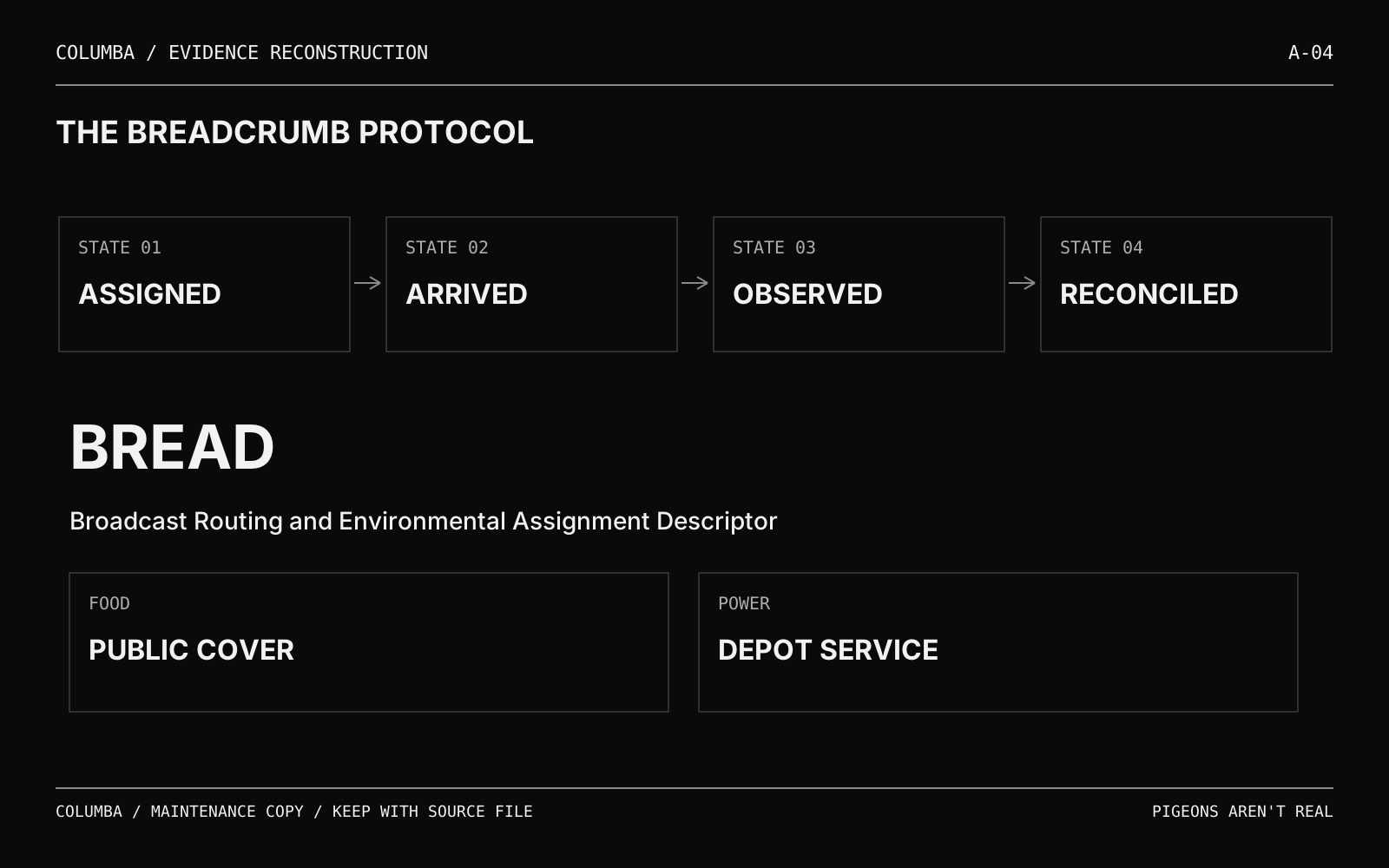
- BROADCAST ROUTING AND ENVIRONMENTAL
- ASSIGNMENT DESCRIPTOR
- ASSIGNED > ARRIVED > OBSERVED > RECONCILED
- FOOD
- COVER / POWER: DEPOT
BREAD envelope / Assignment record / Sector R08
assignment_id: BR-R08-114
scene_key: WEST-SQUARE-BENCH-C
fleet_identity: R08-16
chassis_identity: CH-604
behavior_profile: HESITANT-WALKER
cover_event: ORDINARY-FEEDING-ACTIVITY
observation_window: LOCAL-SLOT-B
credibility_budget: LOW-VISIBILITY
observed_at: populated only by an actual scene observation
uploaded_at: populated at depot transfer
independence_key: derived from the originating scene, not the upload job
completion_state: ASSIGNED / ARRIVED / OBSERVED / RECONCILED
The distinction between fields is precise. Four status words cannot be replaced by one without losing information.
The exemplar's handwritten warning is less technical: “Do not count the dispatch instruction as proof that the bird went.”
Someone had already done so often enough that it needed to be written down.
4.6 THE PUBLIC DID THE SCHEDULING
Every respectable explanation begins with appetite. The bird is there because it wants food. The flock gathers because the birds follow one another. The old man returns because he enjoys feeding them.
COLUMBA's scheduler treats those explanations as infrastructure. It does not need the old man to know anything. It does not even need him to be consistent forever. It only needs his routine to reduce the cost of maintaining a plausible observation point.
That is the uncomfortable elegance of the arrangement. The public is not secretly employed by the program. Its ordinary conduct makes the program cheaper.
But cheap tasking does not solve physical maintenance. Devices wear out. Batteries reach their reserve threshold. Scene spools fill. A pigeon that remained on assignment forever would become a remarkably expensive way to record the same bench.
At some point, the machine has to go home.
The next file explains why home was permitted to look exactly like a row of birds resting on a wire.